
Power Usage Effectiveness (PUE) is total facility energy divided by IT energy — and for most data centers, the gap between a mediocre 1.6 and an excellent 1.2 lives almost entirely in the cooling plant. The levers are well known: more free-cooling hours, warmer water, better airflow containment, smarter sequencing. What simulation adds is numbers per lever, for your climate and your load profile, before you commit capital.
Which lever is worth the most?
Usually the one that raises the temperature at which you reject heat. Air-side or water-side economizers exploit hours when outdoor conditions can absorb the load without running chillers — a wet-bulb-based feasibility count over a real weather year (EPW/TMY3 data) tells you exactly how many hours your site offers. Direct-to-chip warm-water cooling goes further: at 40–45°C supply water, many climates support chillerless operation year-round, collapsing the largest energy consumer in the plant to zero.
How do you compare air, direct-to-chip, and immersion fairly?
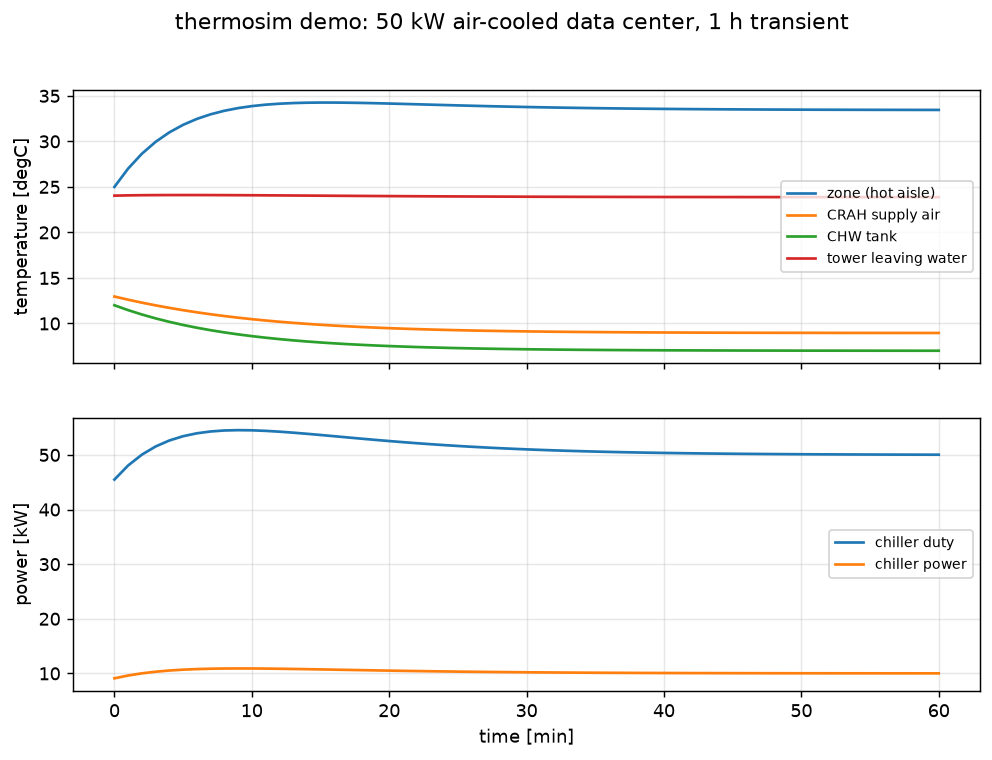
Model them on the same plant, same weather, same IT load, and read PUE, water use (WUE), and per-component energy from the same report. That requires a simulator that treats all three technologies as first-class citizens — including two-phase immersion, where the physics (nucleate boiling, condenser coils) differs fundamentally from air coils. This is precisely the use case Datacenter Cooling was built for: its demo facility runs 30 kW air-cooled, 20 kW direct-to-chip, and 15 kW two-phase immersion simultaneously on one chilled-water plant, and a full 8,760-hour year solves in about a minute — fast enough to iterate designs interactively.
What should a credible study include beyond PUE?
- WUE alongside PUE — evaporative plants trade water for energy; a Phoenix-style water-vs-energy A/B belongs in every hot-climate study
- Failure ride-through — pump trips, chiller trips, N+1 failover, and thermal-storage buffer time, verified transiently rather than assumed
- Sensitivity ranking — a tornado analysis showing which parameters actually move annual energy, so instrumentation and commissioning focus where it matters
- Validation — component models benchmarked against published data (ASHRAE psychrometrics, manufacturer chiller curves, tower correlations), or the whole exercise is decoration
Simulation-driven design won’t pick your cooling technology for you — but it replaces vendor claims and rules of thumb with your-site, your-load numbers, and that changes which conversations you have with stakeholders.