

If your design spans a TRNSYS plant model, an EES equation set, and a COMSOL heat-exchanger check, none of those tools can run multi-objective optimization across simulation tools on their own. TRNSYS’s built-in genetic algorithm, EES’s min/max routines, and COMSOL’s EGO solver each stop at the edge of their own model file. You end up optimizing three pieces separately, then reconciling trade-offs by hand — or worse, picking whichever tool is easiest to script and ignoring the coupling entirely.
This is the specific gap Multi Optimization was built to close: one Pareto front, driven by parallel multi-objective optimization, that calls TRNSYS decks, EES equation sets, and COMSOL models as sub-evaluations of the same generation. Below is how each tool’s 2026 optimizer stays boxed in, and what a cross-tool run looks like instead.
Why TRNSYS, EES and COMSOL Can’t Optimize Across Each Other
COMSOL 6.3 introduced the EGO solver — Efficient Global Optimization — and COMSOL 6.4 refined it. EGO builds a Gaussian-process surrogate of your objective and searches the design space without gradients and without an initial guess, according to COMSOL’s own solver documentation. That’s a real improvement for hard, non-convex single-model problems. But EGO is scoped to one COMSOL model. COMSOL’s documentation recommends running a local gradient solver afterward to polish the result — there’s no mechanism to hand a partial result to TRNSYS or EES and keep optimizing.
TRNSYS is on a similar single-tool track. Transsolar’s TRNSYS news page lists the active 2026 maintenance items: support for the SIA2024:2021 and DIN EN 16798-1:2019 standards, and compatibility with Trnsys3D for SketchUp 2024. All are inside-TRNSYS fixes. None of them mention a link to COMSOL or EES, because TRNSYS’s optimizer — like EES’s — only ever sees its own deck or equation set.
The result: three capable optimizers, three separate design spaces, no shared front. If your chiller plant is in TRNSYS and your cold plate is in COMSOL, optimizing them separately means you’re guessing at the interface — inlet temperature, flow split, approach temperature — instead of letting one search find the joint optimum.

How Multi Optimization Runs Multi-Objective Optimization Across Simulation Tools
Multi Optimization’s engine drives NSGA-II or NSGA-III batches where each individual in a generation can be evaluated by TRNSYS, EES, or COMSOL — or by more than one, in sequence, if your model couples them. As a multi objective optimization tool or software, it treats each solver call as a sub-evaluation feeding one shared Pareto front, not three independent ones. Engineers on our support calls often shorten this to mo optimize — running the shared batch instead of three separate sweeps.
In practice that means: a chiller plant sized in a TRNSYS deck, a cold plate geometry solved in COMSOL, and a refrigerant-side equation set in EES all report back to the same generation of candidates. The optimizer ranks candidates by every objective at once — plant PUE, cold plate pressure drop, refrigerant charge — and advances the population accordingly.
Example: chiller plant plus cold plate
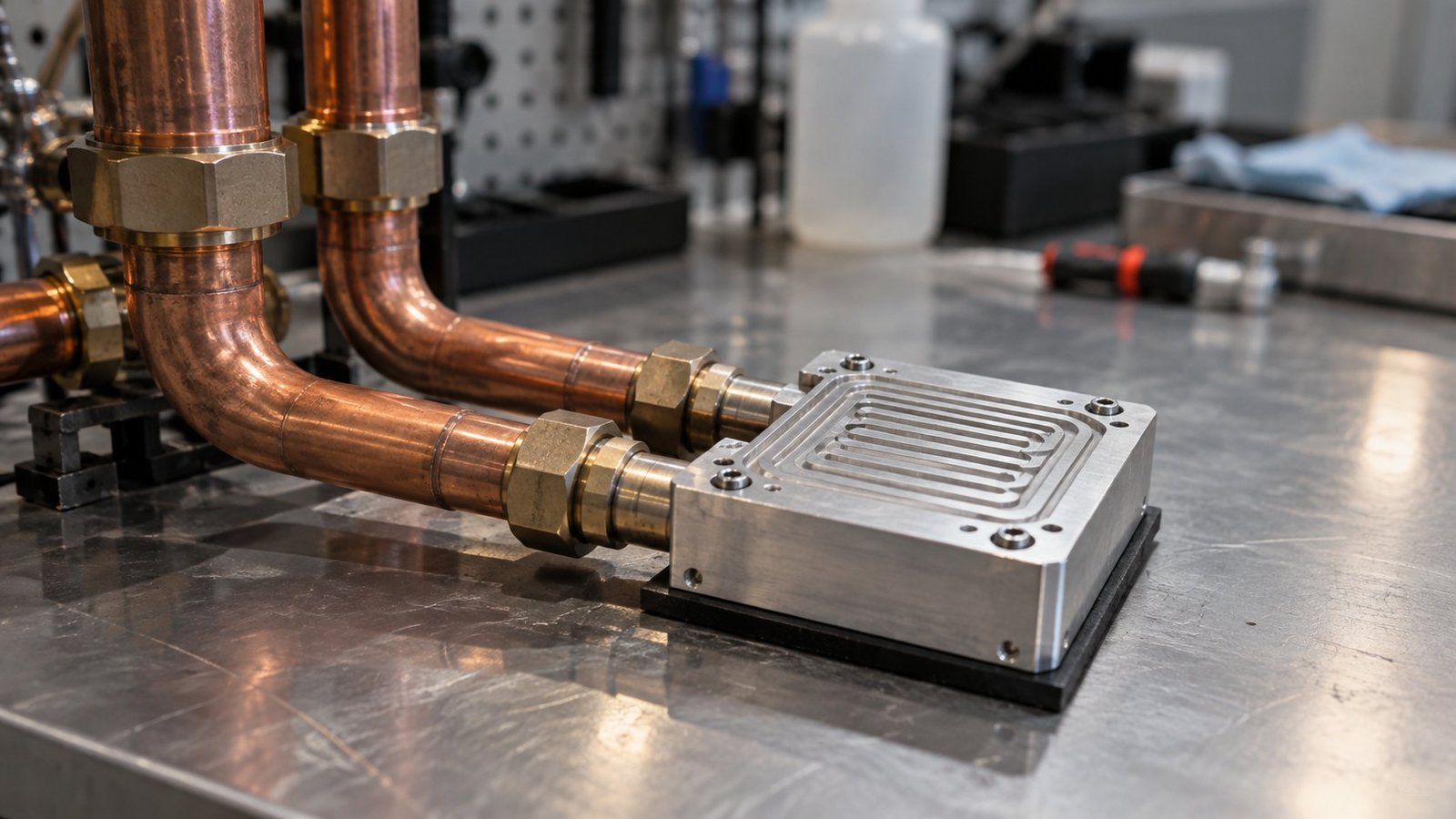
A data center retrofit we worked on optimized a TRNSYS-modeled chiller plant against a COMSOL-modeled cold plate, with EES handling the refrigerant cycle. Three objectives: minimize plant PUE, minimize cold plate junction-to-fluid resistance, minimize refrigerant charge. Population size 48, run across 32 cores, 60 generations. TRNSYS and EES evaluations run in seconds each; COMSOL’s finite-element cold plate solve is the bottleneck at roughly 40 seconds per candidate. Multi Optimization parallelizes across cores so the COMSOL calls don’t serialize the whole batch.
- Candidate parameters (flow rates, approach temperatures, geometry) shared across all three tools for every evaluation
- Each tool’s result folded into one fitness vector per candidate, not scored separately
- Constraint checks, like maximum pump head, applied before a candidate reaches COMSOL, to skip expensive solves that would fail anyway
- Convergence tracked on the combined front, across all objectives, not per tool
What a Cross-Tool Run Looks Like Generation by Generation
The first generation — what we log internally as multi 0 — is a Latin hypercube sample across every parameter, TRNSYS-side and COMSOL-side together. From there NSGA-II ranks candidates by non-domination and crowding distance across all objectives, regardless of which tool produced them. A typical multi optimization run for a two-tool coupling like this converges in 40 to 70 generations. Add COMSOL’s EGO solver as a local refinement step afterward on the best candidate’s COMSOL sub-model, and you tighten the cold plate result without re-running the full cross-tool front.
FAQ
Can COMSOL’s EGO solver replace a cross-tool optimizer?
No. EGO — new in COMSOL 6.3 and refined in 6.4 — optimizes inside one COMSOL model using a Gaussian-process surrogate. It doesn’t call TRNSYS or EES, and COMSOL’s own documentation has it hand off to a local solver afterward, still inside COMSOL.
Do TRNSYS’s 2026 updates add any cross-tool support?
No. The SIA2024:2021 standard support, DIN EN 16798-1:2019 compliance, and Trnsys3D/SketchUp 2024 compatibility listed on Transsolar’s TRNSYS news page are all inside-TRNSYS maintenance items, unrelated to co-optimizing with COMSOL or EES.
How many cores does a three-tool run need?
It scales with your slowest tool. In the chiller-plant example above, 32 cores kept COMSOL’s roughly 40-second cold plate solves from bottlenecking a 48-candidate population. Smaller populations run fine on 8 to 16 cores.
Get a Shared Pareto Front Instead of Three Separate Ones
If your project already spans TRNSYS, EES, or COMSOL, stop optimizing each piece in isolation. See how Multi Optimization’s optimization software runs one multi-objective search across all three, or check the tool-specific setups for TRNSYS, EES, and COMSOL.