
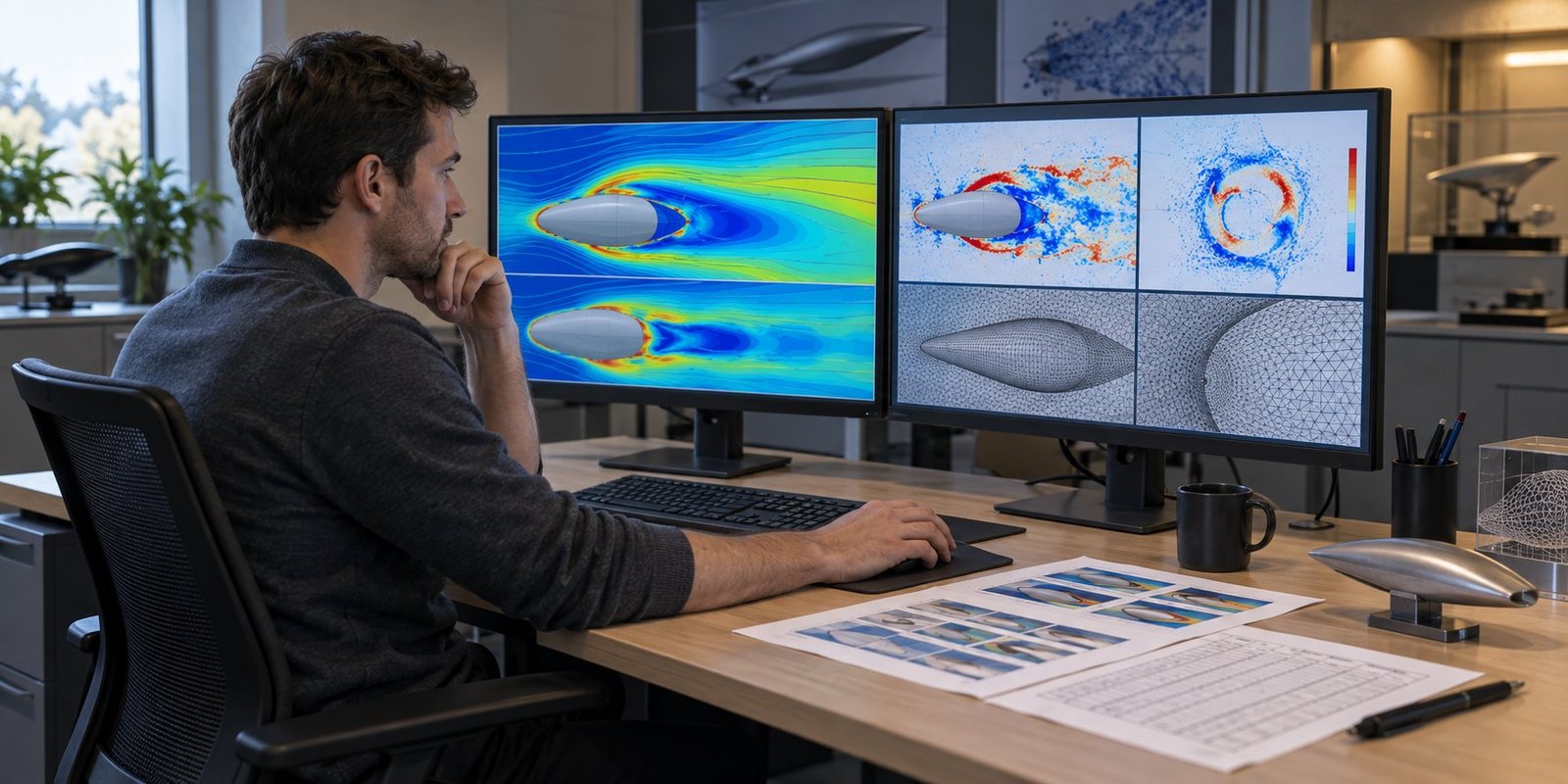
CFD PINN validation should end with a design-use decision, not a single loss value. Before you let a physics-informed neural network or AI surrogate rank concepts, test three separate questions: does it satisfy the governing equations, does it match trusted CFD or experimental results, and does it preserve engineering decisions on unseen cases?
This acceptance-test approach fits practical workflows in COMSOL, STAR-CCM+, TRNSYS, and EES. You define the variables, holdout cases, thresholds, and fallback path before optimization begins. The result is a surrogate that can screen designs quickly while keeping the full solver as the authority when a prediction fails.
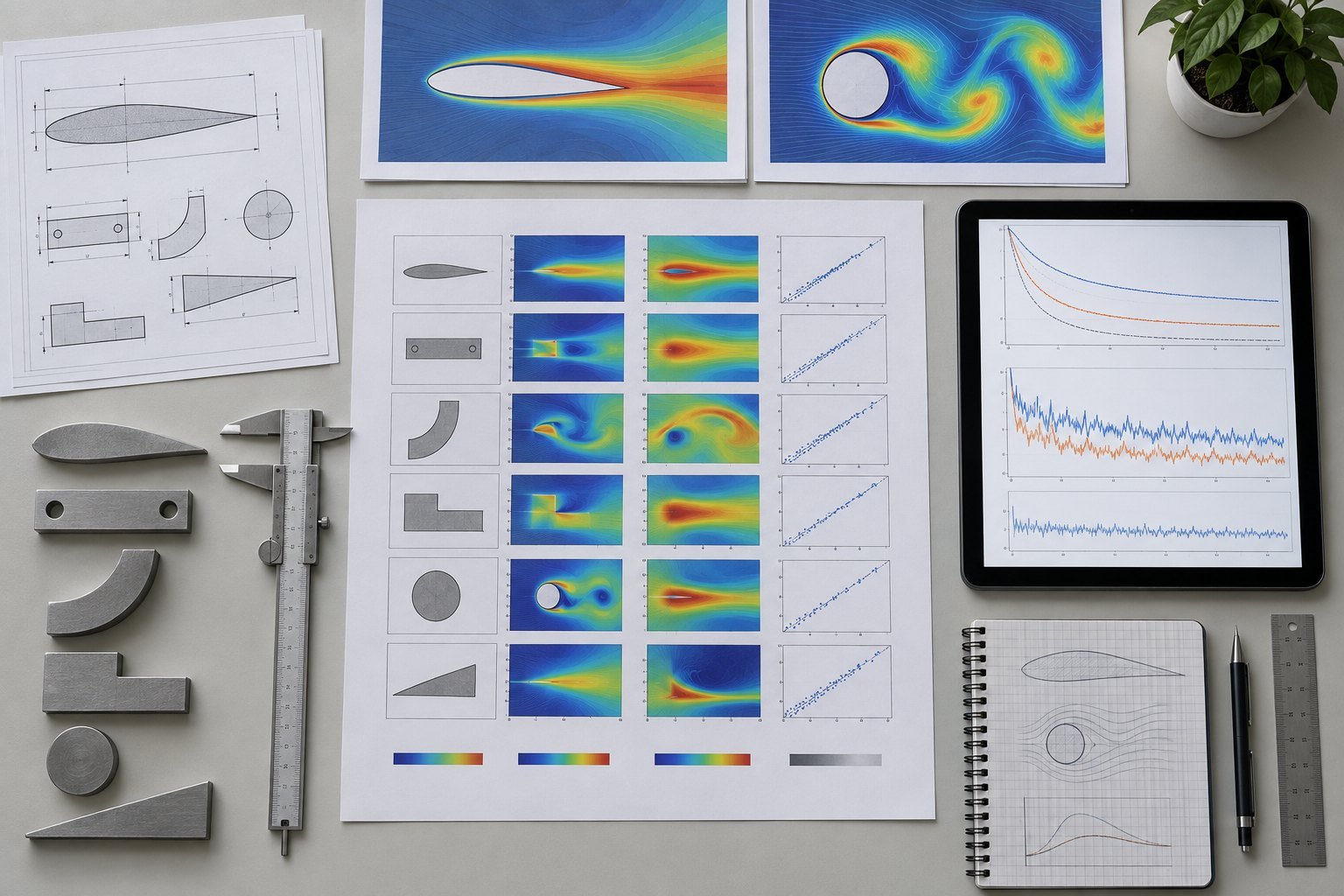
What CFD PINN validation must prove
Treat validation as three gates. A model can pass one gate and fail the next. For example, a network may produce a small continuity residual while missing wall heat flux on a new geometry. It may also match pressure drop but change which Pareto designs satisfy a temperature constraint.
Gate 1 — governing equations
First, measure equation compliance across the intended domain. Check continuity, momentum, energy, turbulence-model terms, and boundary-condition residuals where those terms apply. Report residual distributions, not only their mean. A 0.01 average residual can hide a 0.30 error near a recirculation zone or outlet.
Use the same nondimensionalization and units as the reference solver. Record the sampling locations, time step or steady-state condition, mesh region, and normalization ranges. For transient cases, test several snapshots instead of averaging the entire sequence into one score.
Gate 2 — trusted reference agreement
Next, compare predictions with actual COMSOL or CFD reference runs. Add experimental data when it exists. Compare both field quantities and engineering outputs — velocity, pressure, temperature, drag, lift, pressure drop, heat-transfer coefficient, and fan power may each need separate limits.
ASME V&V 20 frames validation around a specified variable at a specified validation point. It also considers uncertainty in both the computed solution and the measured data. Apply that discipline to your surrogate dataset. State exactly what is being compared, where, and under which operating condition.
Gate 3 — decision preservation
The final gate asks whether the model preserves the decision you would make with the full solver. Compare constraint feasibility, objective ordering, selected designs, and Pareto ranking on unseen cases. This is the difference between acceptable prediction error and acceptable engineering behavior.
- Check whether feasible designs remain feasible after full-solver re-evaluation.
- Measure rank correlation for each objective and compare the top 10 candidates.
- Track false positives — designs the surrogate approves but the solver rejects.
- Track false negatives when screening would discard a design worth testing.
Build a test matrix before training
A useful CFD PINN validation matrix varies the inputs that can change the decision. Randomly splitting rows from one geometry is not enough. Keep complete geometries, boundary-condition families, and operating regions out of training so the holdout measures the behavior you will need during exploration.
Hold out cases that expose extrapolation
For a first acceptance run, hold out at least five geometries or five geometry families if your dataset supports them. Hold out one boundary-condition combination, such as a different inlet profile or thermal boundary. Reserve operating points near both ends of the intended range. Add a few deliberately difficult cases with separation, sharp gradients, or coupled thermal-fluid behavior.
ASME V&V 20 does not certify interpolation or extrapolation across an arbitrary domain. It treats accuracy outside specified validation points as engineering judgment. Your test plan must therefore label every result as interpolation, near-boundary interpolation, or extrapolation. Do not combine them into one average.
Measure outputs that drive the optimizer
List input and output variables before training. A datacenter cooling model may use rack heat load, airflow, supply temperature, and fan speed as inputs. Outputs may include rack inlet temperature, thermal margin, pressure drop, and fan power. A COMSOL model may instead expose displacement, stress, heat flux, or concentration.
- Partition data by geometry, boundary condition, and operating range.
- Select field variables and derived quantities that appear in constraints or objectives.
- Set absolute and relative thresholds for every critical output.
- Evaluate worst-case error, percentile error, bias, and rank preservation.
- Re-run failed cases in COMSOL or the trusted CFD solver before optimization continues.
We specify the holdout strategy in the project record, including case IDs, solver settings, mesh information, convergence criteria, and random seeds. That record makes PINN surrogate validation repeatable when you add new CFD runs or retrain the model.

Set thresholds for engineering decisions
Do not set one universal accuracy target for every output. A 2 percent error in pressure drop may be acceptable for early screening but unacceptable if it changes a pump selection. A 0.5 K temperature error may matter more than a larger error in a low-priority field quantity.
Use a threshold table with three levels: pass, review, and reject. For example, you might require less than 2 percent relative error for pressure drop, less than 0.5 K error for a thermal constraint, and no false-feasible design among the top 20 candidates. These are starting criteria, not universal limits. Tie each value to a design decision and solver uncertainty.
Report worst-case errors alongside mean absolute error. Include the 95th percentile, maximum signed bias, and error by geometry family. A surrogate with a 1.5 percent average error can still be unsafe if one boundary-condition family produces a 12 percent error.
For multi-objective optimization, compare the surrogate and full solver on the same population. If you optimize three objectives over 500 candidates, re-evaluate the selected Pareto set and a sample of dominated points. Record how many candidates change feasibility status and how often the objective order reverses.
Use confidence as a routing signal
A prediction should carry a route, not just a number. If the input lies outside the training envelope, if a residual exceeds its limit, or if an ensemble spread becomes large, send that case to the full solver. Store the new result for the next training cycle only after checking its quality.
Route failed predictions back to CFD
The practical workflow is a gated loop. The surrogate screens a population. The full solver checks the most promising designs and every flagged case. You then update the training set with those solver results and repeat the acceptance checks. This keeps speed in the exploration stage without treating inference as deterministic truth.
Siemens’s May 27, 2026 announcement for Simcenter PhysicsAI reflects this operating model. The add-on creates AI reduced-order models from CFD data, supports near-instant predictions for new geometries, provides built-in error metrics, and retains high-fidelity CFD as the validation reference. The commercial expectation is clear: acceleration must remain attached to verification evidence.
For Multi Optimization projects, we connect this gate to the optimization workflow. A COMSOL or CFD run defines the input and output variables. The surrogate explores the approved domain. Failed predictions return to the full solver before a candidate can influence the final Pareto set. The same pattern can support AI CFD surrogate modeling and downstream optimization.
Keep the acceptance record with the model version. Include the training date, solver version, reference-case list, thresholds, rejected cases, and retraining trigger. When the mesh, physics model, geometry range, or objective set changes, repeat the relevant tests.
FAQ about CFD PINN validation
Is a low physics residual enough?
No. Equation compliance is one gate. You still need agreement with trusted CFD or experimental data and proof that constraints and rankings remain reliable on unseen cases.
How many holdout cases should you use?
Use complete held-out geometries, boundary conditions, and operating regions. Five geometries can provide a starting point, but the required count depends on the design space and failure risk.
What does AI simulation validation include?
It includes physics residuals, reference-solution comparisons, uncertainty or error metrics, worst-case analysis, and decision checks such as feasibility and Pareto ranking.
Make CFD PINN validation an acceptance gate
Approve a CFD PINN or surrogate only after it passes equation, reference, and decision tests. Define the holdouts and thresholds before training. Keep COMSOL or CFD available for failed cases. If you need an engineering workflow that connects AI surrogates with parallel multi-objective optimization, review Multi Optimization’s AI and machine learning software for validated simulation models.