

Surrogate modelling CFD replaces repeated fluid-dynamics solves with a trained model that predicts the same flow and temperature fields in milliseconds instead of minutes or hours. Physics-informed neural networks — PINNs — are the surrogate class you reach for when training data is scarce and the governing physics is known. You embed the Navier-Stokes and energy equations directly into the loss function, so the model learns from both simulation data and the physics itself, not from data alone.
This matters when you run hundreds of CFD cases inside an optimization loop, or when you need a fast model for a data center or HVAC system. Below you’ll see how CFD PINN models are built, where they beat classic data-driven surrogates, and where full CFD still wins.
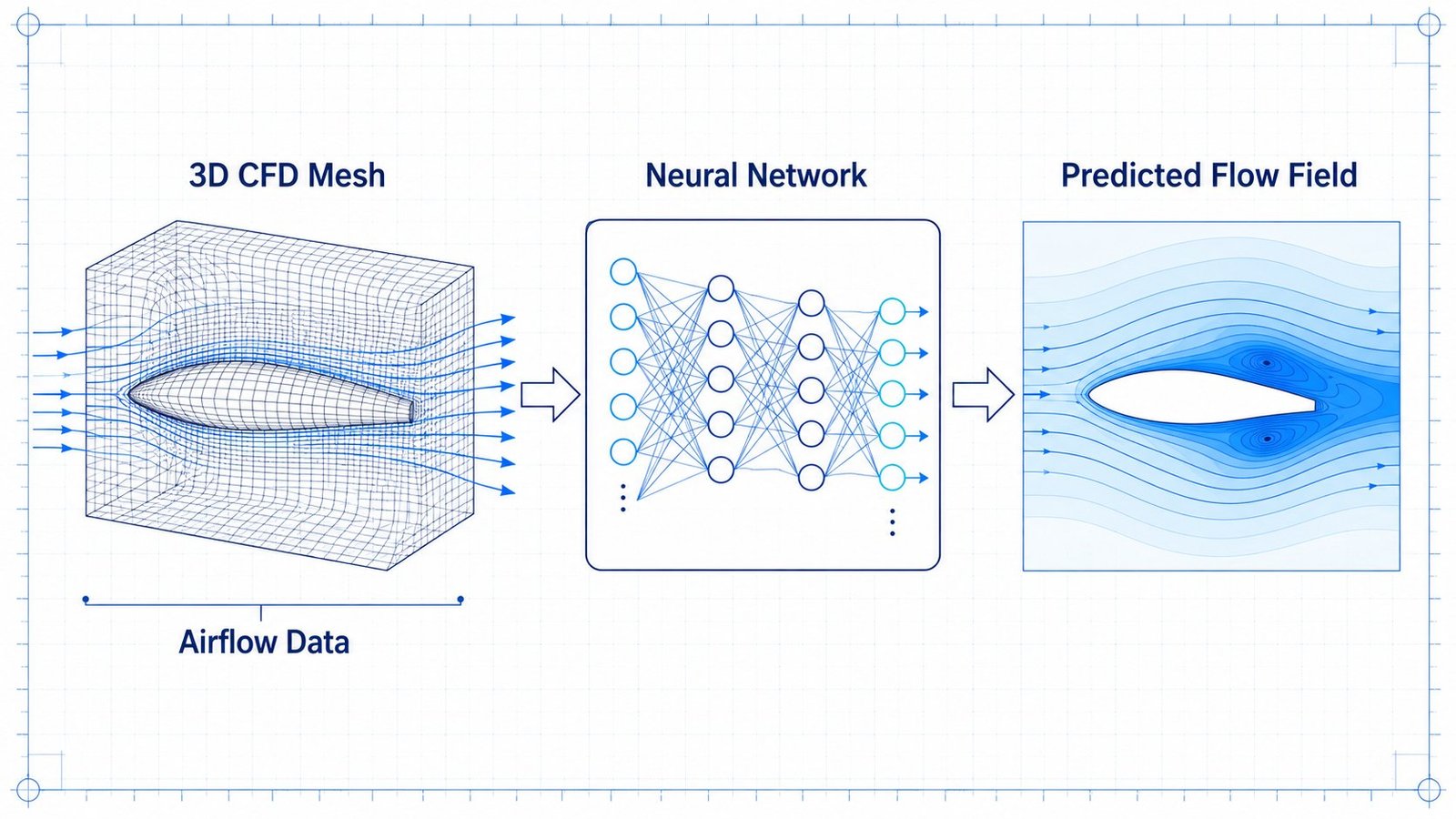
Surrogate Modelling CFD Basics
A CFD surrogate model is a reduced model trained to reproduce the input-output behavior of a full simulation — velocity, pressure and temperature fields — without solving the Navier-Stokes equations at run time. Classic surrogates such as polynomial response surfaces, Kriging or random forests fit only to simulation outputs. Surrogate modelling CFD with a PINN adds a second term to training: the residual of the governing partial differential equations, evaluated at collocation points spread through the domain. That residual keeps the network physically consistent even in regions with no training data.
In practice this cuts the number of full CFD runs you need. We’ve trained CFD PINN surrogates for conjugate heat transfer problems with under 200 full-order simulations, where a pure data-driven network needed 600-1000 cases to reach the same 2% error band on outlet temperature. That’s a 3-5x reduction in solver time before you even start the optimization loop.
How PINN Models Work in CFD
A typical CFD PINN is a multilayer perceptron with 6-10 hidden layers and 64-256 neurons per layer, using tanh or sine (SIREN) activations. Inputs are spatial coordinates, boundary conditions and sometimes time; outputs are velocity components, pressure and temperature. The loss function sums three terms: data mismatch at sensor or CFD sample points, boundary-condition mismatch, and the PDE residual at collocation points sampled from the domain interior.
Training runs 5,000-50,000 epochs with Adam, often followed by L-BFGS for the final polish. On a single A100 GPU, a steady-state conjugate heat transfer case converges in 20-40 minutes. That’s slower to train than a plain data-driven surrogate, but it needs far fewer CFD samples to reach the same accuracy — the actual trade you’re making when you choose AI surrogate models over classic data-driven fits.
Practical Settings We Use
- 8 hidden layers, 128 neurons, tanh activation for laminar duct and heat-sink flows
- 20,000-50,000 collocation points sampled with Latin hypercube, denser near walls
- Adam at 1e-3 for 10,000 epochs, then L-BFGS to convergence
- Non-dimensionalized inputs and outputs — Reynolds and Prandtl scaling stops the residual term from dominating training
Applications: Data Center Cooling and HVAC Design
Data center cooling is the clearest fit. A single rack layout with 40 servers takes 15-30 minutes to solve in a full CFD model. Run that inside a multi-objective optimization loop with 8 rack positions and 3 objectives — inlet temperature, fan power and PUE — and you need thousands of evaluations. Swap in a trained PINN surrogate and each evaluation drops to under 50 milliseconds, so a 200-generation NSGA-II run with a population of 100 finishes in minutes instead of weeks.
The same approach applies to HVAC duct design, electronics cooling and heat exchanger geometry. Anywhere you optimize a shape or a boundary condition against a CFD-derived objective, a PINN surrogate removes the solver from the inner loop. We pair this with data center cooling simulation models and TRNSYS optimization workflows so the surrogate feeds directly into the objective function.
Where CFD PINN Surrogates Fall Short
Surrogate modelling CFD is not a universal replacement for solving the equations. Transient turbulent flows with vortex shedding push PINN training time up sharply, because the residual has to hold at every collocation point across time as well as space. Sharp geometry changes — thin fins, small orifices — need dense collocation sampling near the feature or the residual loss misses the local gradient entirely.
Extrapolation is the other limit. A PINN trained on inlet velocities from 1-5 m/s will not give reliable output at 12 m/s. Keep the training envelope wider than your expected optimization range, and validate a sample of surrogate predictions against fresh CFD runs before you trust the surrogate inside a design loop.
FAQ: CFD PINN Surrogates
How many CFD runs do I need to train a PINN surrogate?
For a single-geometry, parametric case, 100-300 full CFD runs is typical. Complex 3D conjugate heat transfer problems can need 500 or more, depending on how many boundary conditions vary.
Is a PINN surrogate more accurate than a data-driven neural network?
At the same training set size, yes — the PDE residual acts as a regularizer, cutting overfitting. With unlimited training data, a plain data-driven network can match it, but that much CFD data is rarely practical.
Can I use a CFD PINN surrogate with COMSOL or TRNSYS models?
Yes. You train the surrogate on exported CFD field data, then call it from the optimization loop in place of the solver — the same pattern works with COMSOL optimization and EES optimization workflows.
Start Your CFD Surrogate Project
If you’re running CFD inside an optimization loop and each generation takes hours instead of minutes, surrogate modelling CFD with a PINN is worth the setup time. See how we build and validate these models on the AI CFD surrogate modeling page.