
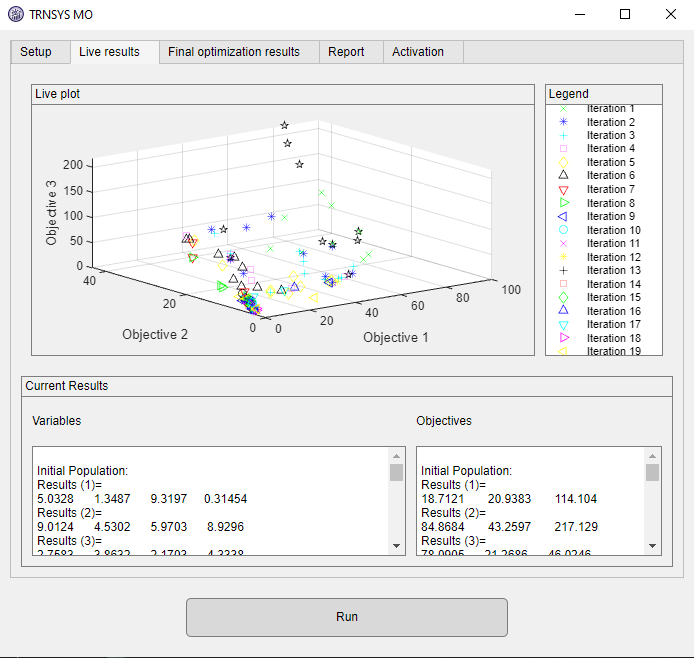
TRNSYS executes one simulation per TRNExe.exe process — but a modern CPU can comfortably run eight or more of those processes at once. For optimization studies, where each generation needs dozens of independent simulations, that means a near-linear speedup: with N cores, a study finishes close to N× faster whenever TRNSYS dominates the runtime.
What breaks when you naively run two TRNSYS instances?
File collisions. A deck writes its outputs — including the objectives file an optimizer reads — to fixed paths, so two simultaneous runs of the same deck overwrite each other’s results. The solution is isolation: give every core its own copy of the deck, its own working files, and its own objectives file. That is exactly what TRNSYS MO automates: each core gets a private deck copy, and the bundled Type 997 “Multi Optimization Parallel” writes objectives to a per-core file named by an environment variable instead of one shared path. Your master deck is never modified.
What speedup should you actually expect?
Close to N× on N cores for simulation-dominated studies — a claim worth being precise about. The optimizer’s own bookkeeping (sorting, breeding, plotting) takes a fraction of a second per generation, so if one simulation takes 2 minutes and you evaluate a 40-design generation on 8 cores, the generation takes about 10 minutes instead of 80. Overheads that erode the ideal: fewer designs than cores in the final generation, simulations of unequal length (cores idle waiting for the slowest), and RAM pressure if N instances exceed memory.
Practical tips for overnight optimization runs
- Set a per-simulation time limit. One hung simulation should cost you one penalized design, not the whole night.
- Penalize failures instead of aborting. Some corner of the design space will always crash the solver; treat it as a bad design and move on.
- Launch instances minimized and auto-dismiss error dialogs — a modal dialog on instance 3 of 8 silently stalls a quarter of your throughput.
- Leave one core free for the OS and the optimizer GUI if you use the machine while it runs.
TRNSYS MO applies all four automatically, converts legacy Type 945/946 decks on the fly, and shows every simulation on a live Pareto plot as it lands — so a study you’d previously schedule for a week of machine time fits in an overnight run.