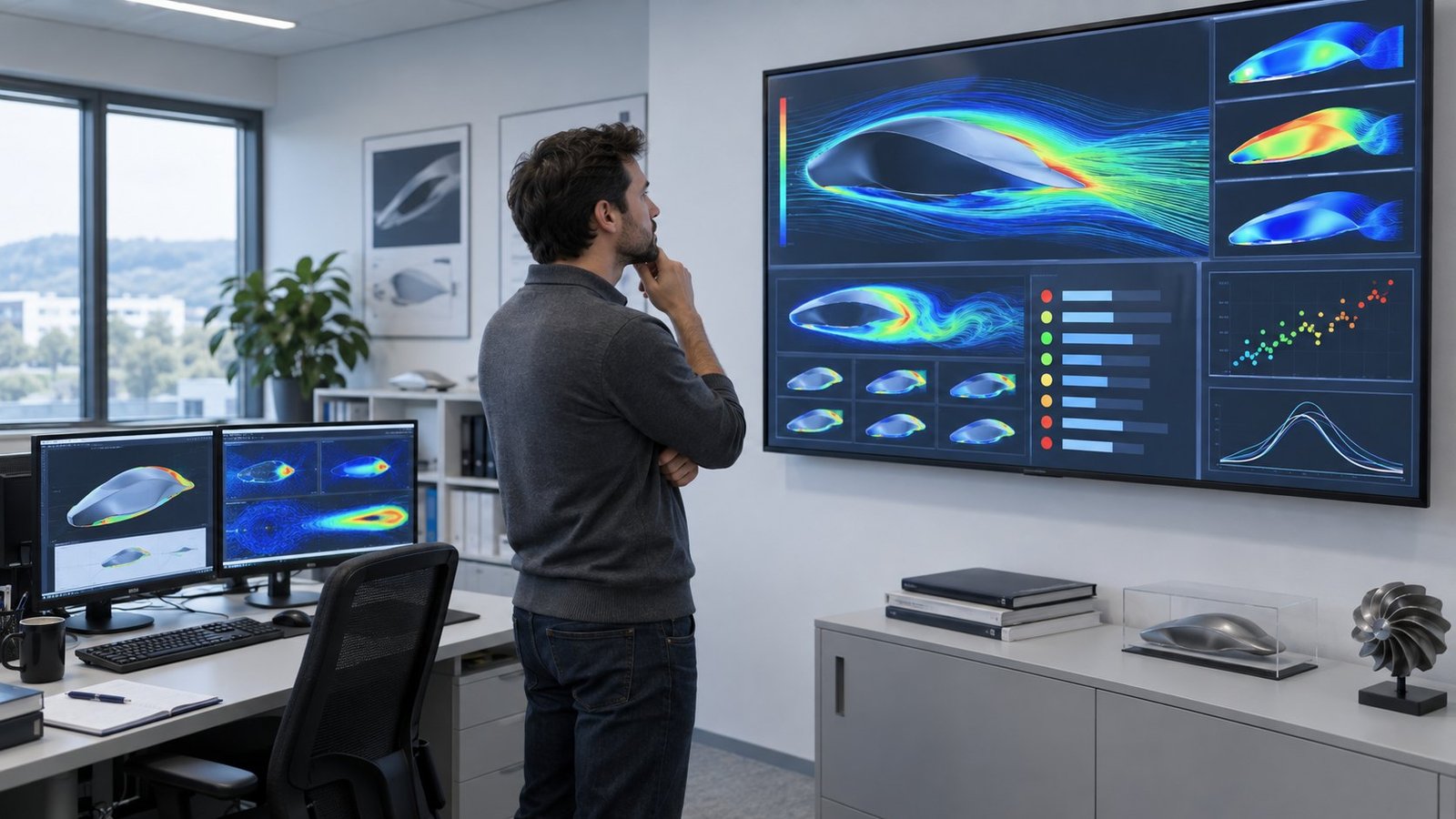
After your first CFD cases are generated, the next simulation should be the one most likely to improve the model or expose a dangerous blind spot. That is the practical purpose of CFD PINN active learning. You train a surrogate, measure where it performs poorly or sees unfamiliar inputs, query the design pool, and send only selected cases to the external solver.
The useful question is not whether uncertainty looks impressive on a chart. You need to know whether a new case earns its solver time. NVIDIA PhysicsNeMo 26.08 adds latent-novelty acquisition for external-aerodynamics models and CFD surrogate benchmarking. Multi Optimization applies the same closed-loop discipline to parallel TRNSYS, EES, and COMSOL workflows.
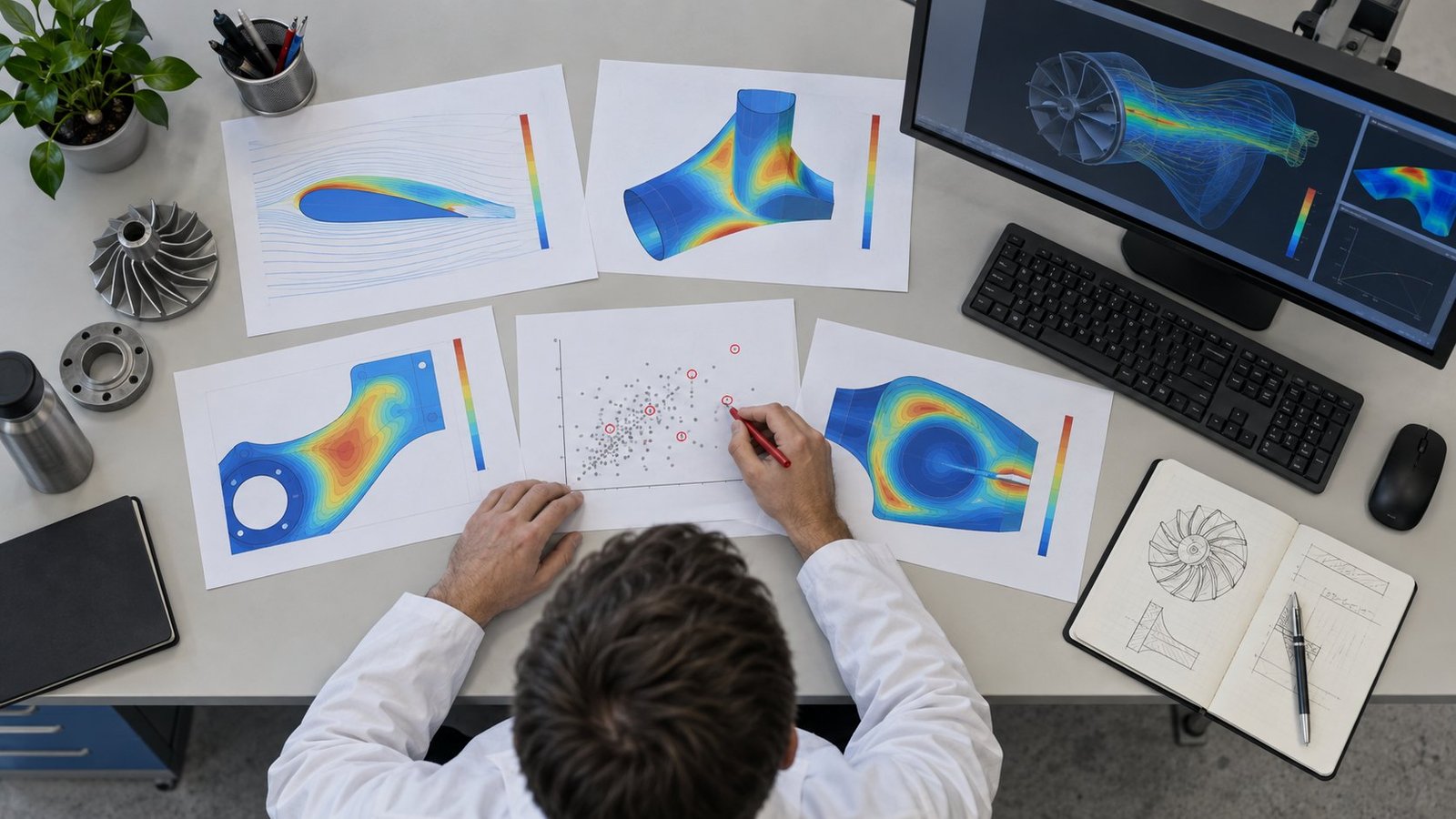
CFD PINN active learning starts with the next-case question
Treat each possible simulation as a purchase decision. The cost is solver time, queue time, storage, and review effort. The return is better prediction in a target region, stronger coverage of the design space, or evidence that the surrogate should not be trusted there.
A practical campaign begins with a defined pool of candidate inputs. For external aerodynamics, those inputs may include inlet velocity, yaw angle, ride height, a geometry parameter, or a turbulence-model setting. For cooling studies, they may include rack load, supply-air temperature, airflow rate, tile opening, and containment configuration. Sample variables that move your engineering decision, not variables that only make the dataset look broad.
Keep the objectives visible from the first batch. A three-objective aerodynamic campaign might track drag, lift, and a pressure-uniformity measure. A datacenter study may track maximum rack inlet temperature, fan power, and PUE. If one candidate improves only a low-priority metric, it should not displace a case that tests a safety limit.
Start with a measured baseline
Use a fixed validation pool before the first query. A useful starting design is 64 initial cases, an eight-case validation pool, and eight concurrent solver slots when your license and hardware allow it. The figures are adjustable. The discipline is not. Keep the validation cases untouched so every active-learning round has a comparable score.
Record solver convergence, failed meshes, force or heat-balance residuals, and output ranges. A candidate with high model uncertainty but a failed CFD run is not a useful label. It is a data-quality event that needs a separate status.
See also: CFD PINN
What PhysicsNeMo 26.08 changes in the loop
Release Notes — NVIDIA PhysicsNeMo Framework 26.08 describes two changes that matter for the next-case decision. Its external-aerodynamics workflow adds a latent-novelty acquisition strategy based on the model’s out-of-distribution guard. PhysicsNeMo CFD also adds benchmarking for deterministic, closed-form, and sampling-based CFD surrogate models.
Latent novelty gives you a different signal from pointwise prediction spread. It asks whether a candidate resembles the model’s learned representation. That is useful when a candidate sits outside the geometry, flow condition, or operating envelope represented by your first cases. A model can be confidently wrong in an unfamiliar region, so novelty deserves a place beside uncertainty.
The Active Learning — NVIDIA PhysicsNeMo Framework documentation describes a repeatable loop with training, querying, labeling, and an optional metrology phase. Training updates the learner with newly labeled cases. Querying chooses candidates. Labeling obtains ground truth. In CFD, labeling still means running the external solver or a connected simulation workflow.
Why the external solver remains the labeler
A PINN or surrogate can estimate a field, but its estimate is not automatically ground truth. The selected design must pass through the solver that defines your production answer. That solver may calculate pressure, velocity, temperature, force, or heat-transfer outputs on the approved mesh and settings.
This distinction keeps CFD PINN active learning tied to engineering evidence. The model proposes which case to run. The external solver supplies the label. Your review process then decides whether the result is valid enough to enter the training pool.
Choose novelty, uncertainty, or random sampling deliberately
Uncertainty guided CFD is useful when the model can identify regions where its prediction is unstable or poorly supported. It is not automatically better than random sampling. Uncertainty can concentrate selections around noisy inputs, repeat nearly identical cases, or miss a broad region that the model represents with unjustified confidence.
Random sampling remains a strong baseline because it tests whether a more complex acquisition rule earns its extra machinery. Compare strategies using the same solver budget. For example, run 16 new cases with random sampling, 16 with uncertainty sampling, and 16 with latent novelty. Compare the same held-out cases, the same output metrics, and the same failure handling.
- Use random sampling to widen coverage after a narrow initial campaign.
- Use uncertainty sampling to target unstable predictions inside the known design envelope.
- Use latent novelty to test unfamiliar geometries or operating conditions.
- Use a mixed batch when one strategy would otherwise dominate selection.
- Reject duplicate candidates before they consume solver capacity.
Adaptive PINN sampling should also respect engineering priorities. A candidate near a maximum-temperature limit may deserve selection even if its uncertainty is moderate. A candidate with high novelty but no relevance to the design decision may wait. Rank information value, objective relevance, solver feasibility, and diversity together.

Turn parallel solver runs into trusted training cases
CFDTwin is useful evidence of where surrogate work is heading. Its open-source GUI and Python toolkit package design-space sampling, batch ANSYS Fluent simulation, model training, and downstream optimization into one workflow. The lesson is practical: a surrogate earns value when it shortens the design loop, not when it exists as an isolated neural-network experiment.
Multi Optimization follows the same operational pattern across its simulation range. Candidate points can be evaluated concurrently through parallel TRNSYS, EES, or COMSOL runs. The scheduler can use available cores and licenses to process a batch, while the optimization layer tracks objective values and constraints.
For a thermal design, you might sample airflow rate, supply temperature, and equipment load while minimizing fan energy and maximum inlet temperature. For a COMSOL multiphysics case, you might vary material thickness, boundary flux, and geometry while tracking peak stress, displacement, and temperature. Keep the batch large enough to use eight solver slots, but small enough to review failures before the next query.
Promote a case only after review
Exploratory data becomes trusted training data through a promotion rule. First, confirm that the solver completed with the intended mesh, boundary conditions, and convergence settings. Next, check balances and objective values against physical limits. Then compare the case with nearby designs to catch discontinuities caused by setup errors rather than physics.
- Queue the selected design and preserve its input configuration.
- Run the external CFD, TRNSYS, EES, or COMSOL model.
- Store fields, objectives, convergence records, and failure codes together.
- Review the result against numerical and engineering acceptance checks.
- Promote the case to the training pool, or retain it as an excluded diagnostic.
This separation prevents bad labels from teaching the surrogate the wrong behavior. It also gives you an audit trail for why a case was selected, how it was solved, and why it entered or stayed outside the training set.
Metrology decides whether the loop is production-ready
Validation loss alone does not tell you whether the next-case loop is safe to use in production. The PhysicsNeMo active-learning documentation adds metrology for this reason. After training or fine-tuning, run the surrogate through a solver, simulator, or workflow that checks performance and stability beyond ordinary model metrics.
For CFD PINN active learning, metrology can include a fresh solver comparison at three operating points, a force or heat-balance check, and a review of the worst local field error. It can also test whether optimization proposes designs outside the labeled envelope. If a model improves average error but produces an unacceptable peak temperature, the loop has not improved the engineering decision.
Set a promotion gate before reviewing the results. For example, require all three objectives to remain within agreed tolerances on the holdout set, require no unexplained solver failures, and require the next optimization batch to stay inside the approved variable bounds. The exact tolerance belongs to your application. The gate should be explicit and repeatable.
See also: cfd surrogate model
FAQ: CFD PINN active learning decisions
Does active learning CFD remove the external solver?
No. The external solver remains the labeling step. Active learning reduces unnecessary solver runs by selecting cases with higher expected value.
Should uncertainty always choose the next case?
No. Compare uncertainty with random and novelty-based selection under the same budget. Use the strategy that improves your held-out objectives and coverage.
What does metrology add?
Metrology checks the trained surrogate inside a realistic solver or workflow. It exposes instability, unacceptable field errors, and optimization proposals outside the trusted operating range.
Where should you start?
Start with a fixed validation pool, a defined candidate space, and one batch of parallel solver runs. Add uncertainty or latent novelty only after you can measure improvement against random sampling.
Conclusion — make the next case earn its place
The best next CFD case is not simply the most uncertain point. It is the case that tests a relevant objective, expands trusted coverage, fits your solver capacity, and survives metrology. PhysicsNeMo 26.08 gives you novelty acquisition and surrogate benchmarks. CFDTwin shows how sampling, batch simulation, training, and optimization can share one workflow. Multi Optimization extends that operating model across parallel TRNSYS, EES, and COMSOL studies. See our AI CFD surrogate modeling workflow to connect active learning with practical design optimization.