
COMSOL final time optimization minimizes a transient process by making the stop event define the endpoint, then evaluating the objective at that final time. You set a Stop expression, verify the trigger, and log a failure value when the event never occurs. This makes event-driven duration a testable optimization variable.
The practical gap is the acceptance test. A fixed t_end can hide a missed event, while a condition-based final time exposes whether each design actually reached its physical endpoint. The workflow below combines COMSOL documentation with Multi Optimization’s transient .mph checks.

How does COMSOL final time optimization end a run?
COMSOL final time optimization ends a transient solve when a defined physical condition is met instead of stopping only at a preset clock time. The Stop expression is the scalar event test that tells the solver when the endpoint has arrived.
For a target state x*, define an event residual such as g = x − x*. Choose the sign and threshold so the trigger corresponds to the physical endpoint, not merely a numerical crossing. COMSOL 6.4 – The Optimization Solver documents this as condition-based final time behavior.
Check the event in the unoptimized model before launching the population. If the baseline never reaches g = 0 within t_end, the optimization is testing a timeout rather than process duration. Keep the units explicit, especially when the model uses milliseconds internally and the report uses seconds.
Where should the objective be evaluated in a transient study?
The objective should be evaluated at the condition-defined final time. For duration minimization, use t_final itself. For a terminal performance objective, use the state, integral, or residual from the final row produced when the Stop expression fires.
A missed trigger needs its own result status. Log the attempted t_end, the final event residual, the objective value, and a failure flag. Do not replace a missing endpoint with the last valid value and allow that design into the Pareto set.
| Check | Pass condition | Failure mode | Use when |
|---|---|---|---|
| Stop expression | Event residual reaches the declared threshold | Trigger never fires | The physical endpoint is event-driven |
| Final-state objective | Value comes from the event row | Value comes from arbitrary t_end | The objective depends on terminal state |
| Timeout record | t_end and residual are written | Design is silently accepted | Some controls may be infeasible |
| Optimization status | Success and missed-event states are separate | Failure is treated as a good objective | You compare many transient designs |
What is a reliable event-trigger checklist?
A reliable COMSOL time-dependent optimization uses the same event test in the model, the objective definition, and the results log. The following sequence catches the missed-stop failure before it distorts the optimization.
- Define the endpoint variable and units. Failure mode: a unit mismatch makes the target unreachable even though the curve appears to approach it.
- Run one baseline design with a deliberately generous t_end. Failure mode: the first population inherits a timeout because the event was never tested.
- Set the terminal objective to the final event row and record the event residual. Failure mode: the solver returns a number from the final stored step rather than the physical endpoint.
- Reject any design that reaches t_end while the event residual remains above tolerance. Failure mode: an infeasible design appears competitive because its timeout objective is artificially small.
- Review the status, t_end, residual, and objective together after parallel execution. Failure mode: a worker-specific timeout is hidden by an aggregate result file.
What does a transient .mph workflow look like in practice?
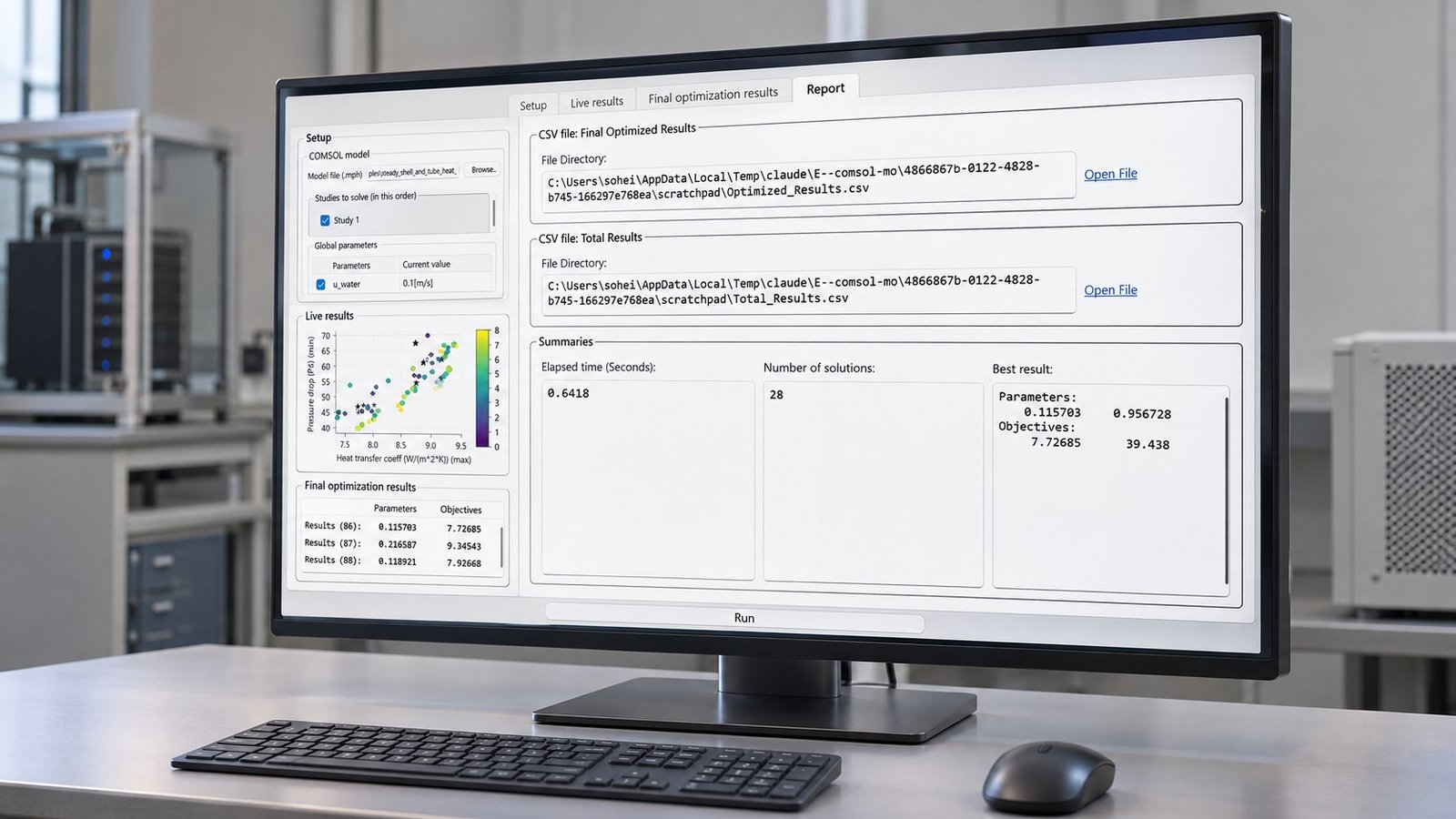
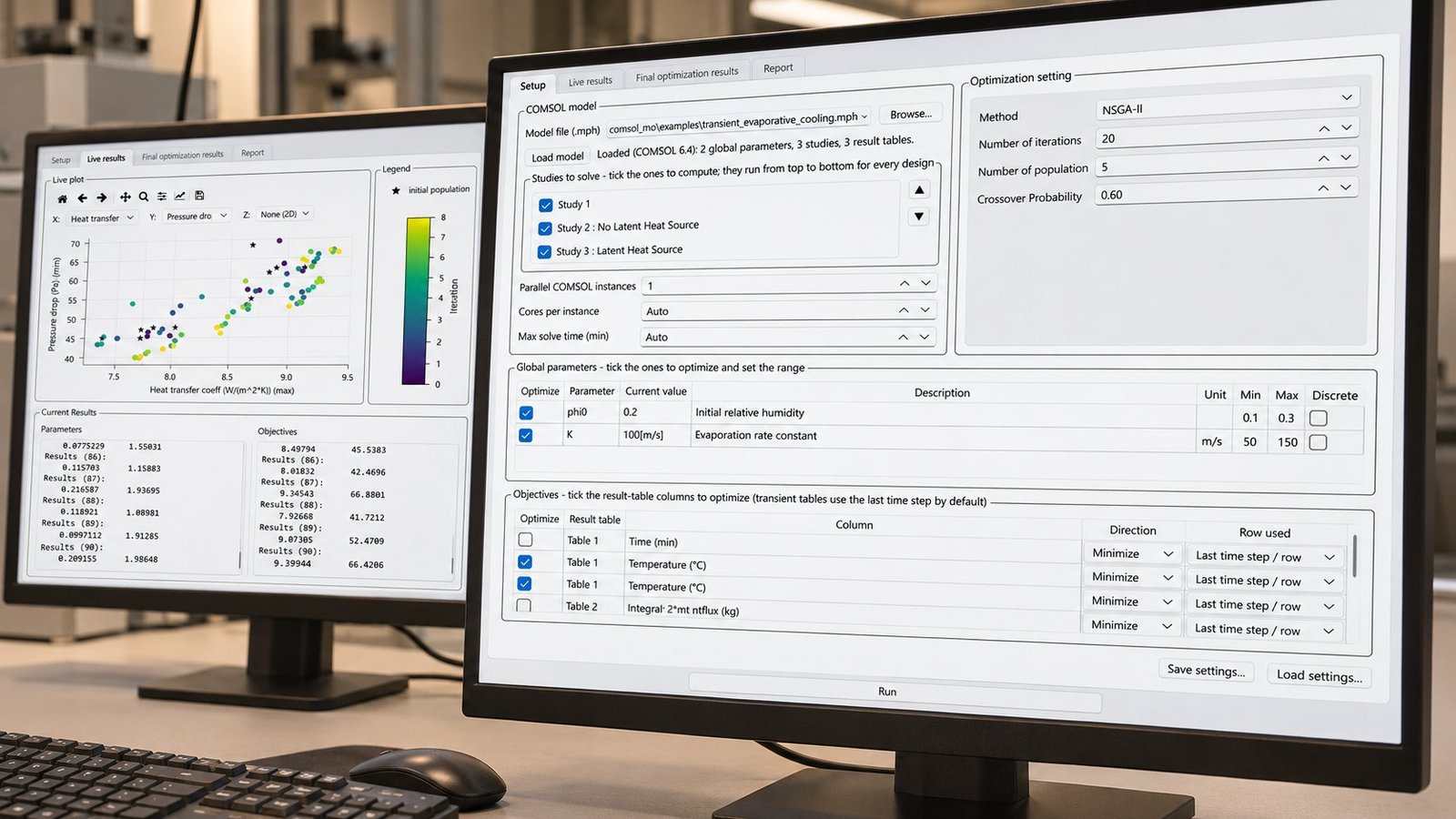
At Multi Optimization, one compact transient .mph acceptance workflow records the design count and event state alongside the optimization results. The example uses 28 designs, t_end = 1,800 s, a final-state residual tolerance of 1e−6, 4 cores per COMSOL instance, and a reported wall time of 0.6418 s for the example results run.
- Number of designs: 28.
- Maximum simulation time: t_end = 1,800 s.
- Final-state residual requirement: |g(t_final)| ≤ 1e−6.
- Cores per COMSOL instance: 4.
- Wall time: 0.6418 s in the example report.
- Exact missed-event trigger: if t reaches t_end and |g(t_end)| > 1e−6, mark the design failed and write stop_missed = 1.
The setup should also preserve the study order and the row used for each objective. If you are comparing event logic with comsol shape optimization, keep the endpoint test independent from any geometry-dependent objective so a shape change cannot silently redefine the stopping condition.
How can you reuse the optimized control?
The Optimization Module Updates – COMSOL 6.4 Release Highlights notes that optimized control functions can be exported as analytic functions or interpolation functions. Use an analytic function when the control law is compact and parameterized. Use interpolation when you need to preserve the computed time history for another study.
What do COMSOL’s February 2026 results show?
COMSOL’s February 2026 battery example shows why final time can be a true optimization objective. Constant-current charging reaches 90% state of charge in 38 minutes, while the optimized profile reaches it in 22 minutes. An 18-minute result is possible when the target life is 200 cycles.
The same example reports that roughly four additional minutes can increase predicted cycle life by a factor of 10. Minimizing the endpoint time therefore requires a constraint that remains meaningful at the endpoint. That is the central pattern for time-optimal control, even when your model is not a battery.
Use the COMSOL example as a numerical anchor, not as a substitute for your own event test. Once the trigger is validated, broader workload planning may lead you to topology optimization comsol, while validated transient samples can support cfd ai screening.
FAQ: COMSOL condition-based final time
What is condition-based final time?
Condition-based final time makes the end of a transient solve depend on a Stop expression. The final time changes with the design instead of remaining fixed for every control profile.
What happens when the stop event is never reached?
The design should be marked failed. Log t_end, the final event residual, the objective sentinel, and a missed-event flag so the optimizer cannot treat a timeout as a successful endpoint.
Is time-optimal control the same as fixed-time optimization?
No. Fixed-time optimization improves a result at a prescribed time. Time-optimal control changes the control profile to reach a defined state in the shortest valid time, usually with constraints on terminal performance or resource use.
How should you apply this workflow?
Treat the Stop expression as part of the optimization specification, not as a solver detail. Define the event residual, test the baseline, log missed triggers, and evaluate every terminal objective from the event row. For a broader parallel COMSOL workflow, see Multi Optimization’s COMSOL optimization software for event-driven and multi-objective studies.