
A 3D surrogate model should return a volumetric field when decisions depend on local gradients, hot spots, recirculation, boundary loads, or conservation residuals—not only averages or maxima. Use scalar KPIs when those fields cannot change the decision. For production CFD, specify the field representation, units, boundary-condition envelope, and error gates before collecting training runs.
The distinction is practical. The AAAI 2026 paper Fast 3D Surrogate Modeling for Data Center Thermal Management uses server workloads, fan speeds, and HVAC setpoints to predict a 3D voxelized thermal state. It reports reductions from hours to hundreds of milliseconds and 7% energy savings. Those gains only matter if the predicted field is trustworthy where operators need it.
When should a 3D surrogate model return a field?
Return a field when a local value can change the engineering decision. Return scalar KPIs when the downstream calculation needs only totals, extrema, or averages and no later step reconstructs spatial behavior.
- Use a volumetric field for rack inlet temperature, wall heat flux, wake structure, pressure loss distribution, or any local safety limit.
- Use scalar outputs for total heat rejection, fan power, mean outlet temperature, or a single objective in an optimization loop.
- Use both when optimization needs fast scalar objectives but the final design review needs slices, isosurfaces, or boundary residuals.
- Reject scalar compression if averaging can hide a hot voxel, flow separation, thermal short circuit, or a local pressure violation.
A field surrogate model must preserve coordinates or a fixed topology. A 3D CFD surrogate can use structured voxels, finite-element nodes, or a mesh-aware latent representation. Choose the representation from the decision, not from the neural-network architecture.
What belongs in the field-output specification?
Specify the input encoding, spatial resolution, output variables, units, boundary-condition coverage, sample count, and validation split before training. The table below is the minimum record we use for a volumetric neural surrogate.
| Specification | Minimum record | Use when |
|---|---|---|
| Input encoding | Normalized values plus physical labels: workload in W, fan speed in rpm or %, HVAC setpoint in K | Every control can change the field |
| Mesh or voxel resolution | Topology or grid dimensions and Δx, Δy, Δz in m | Gradients, hot spots, or wakes affect acceptance |
| Output variables | T in K; u, v, w in m/s; p in Pa; q in W/m² where applicable | Reviewers need local physics, not only KPIs |
| Units | Unit attached to every input, output, residual, and error metric | Mixed thermal, flow, and power variables are present |
| Boundary-condition coverage | Inlet, outlet, wall, fan, HVAC, heat-flux, and interface conditions | The model may see changed operating modes |
| Sample count | Total solver runs, failed runs, DOE method, and parameter ranges | The design space is sparse or expensive |
| Validation split | Held-out interpolation cases plus edge-of-envelope cases | You need evidence beyond training fit |
COMSOL’s Introduction to Using Surrogate Models gives two useful constraints. Linear interpolation tables support no more than three input parameters and are weak for nonlinear behavior. For sparse design spaces, COMSOL recommends Latin-hypercube sampling rather than a uniform grid. Record the sampling method with the dataset.
What does a real Multi Optimization case show?
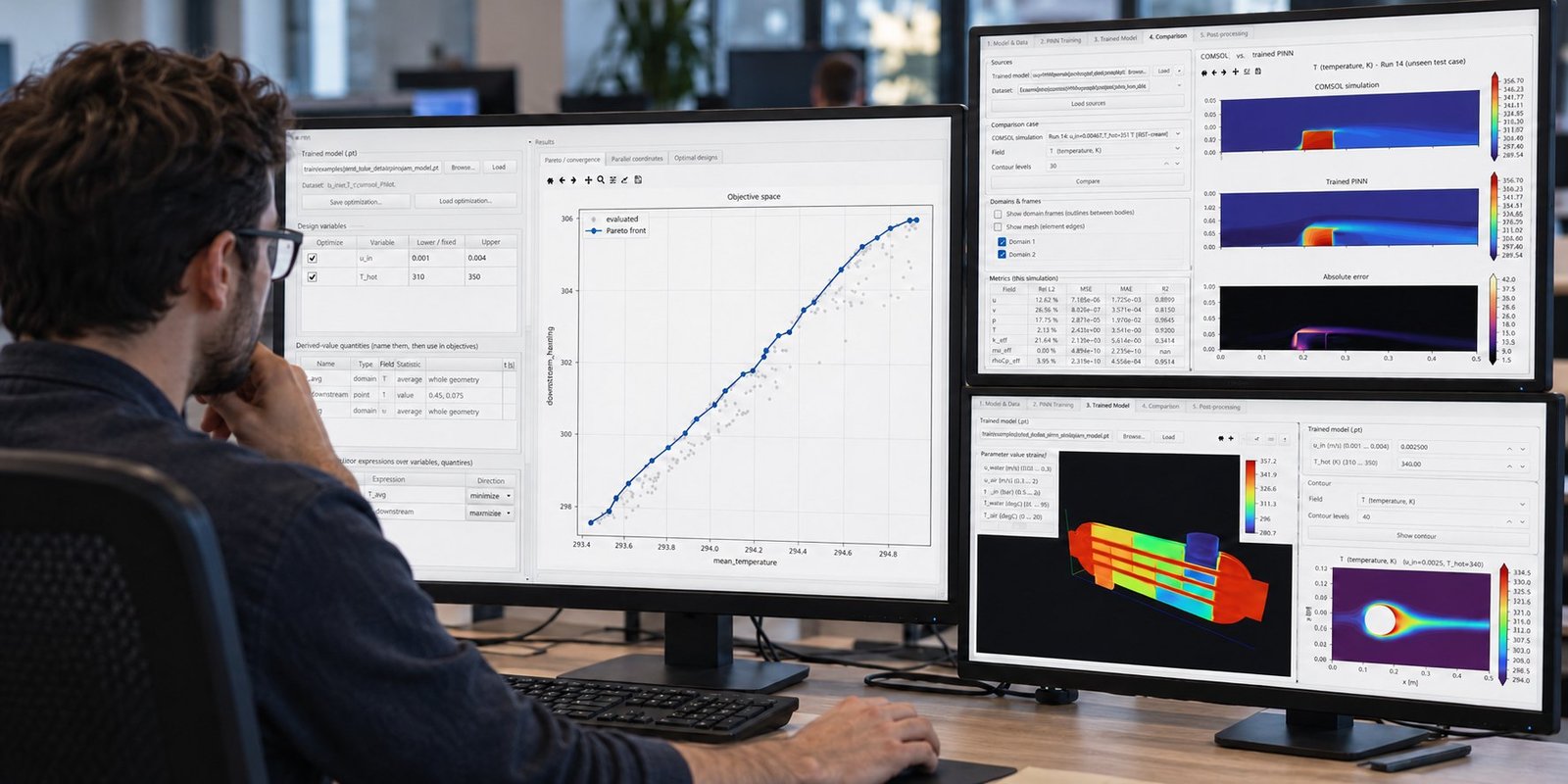
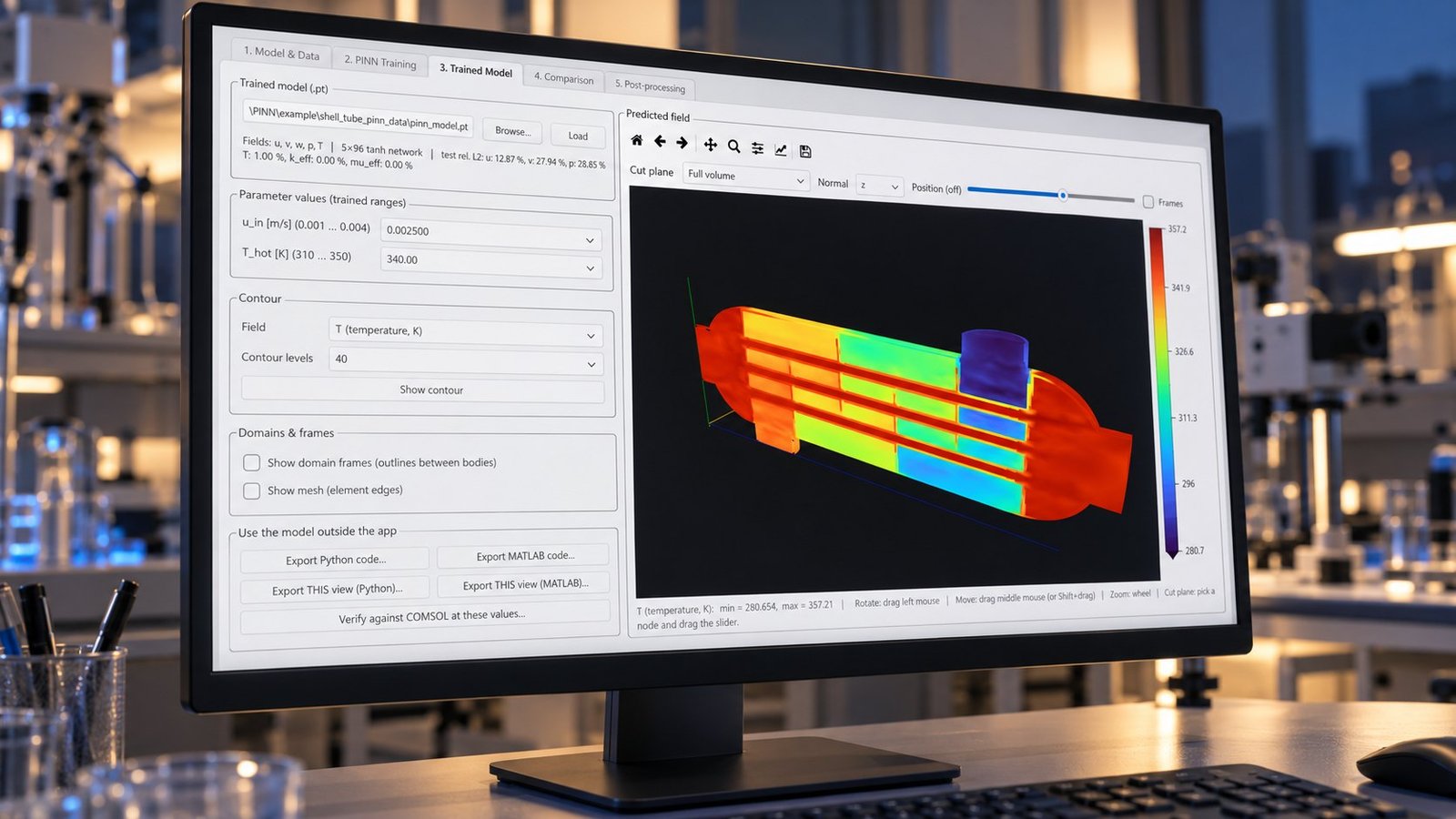
Our heated-cylinder workflow exposes a concrete thermal envelope: u_in from 0.001 to 0.004 m/s and T_hot from 310 to 350 K. The trained-model screen reports test relative L2 errors of 12.87% for u, 27.94% for v, 28.85% for p, and 1.00% for T.
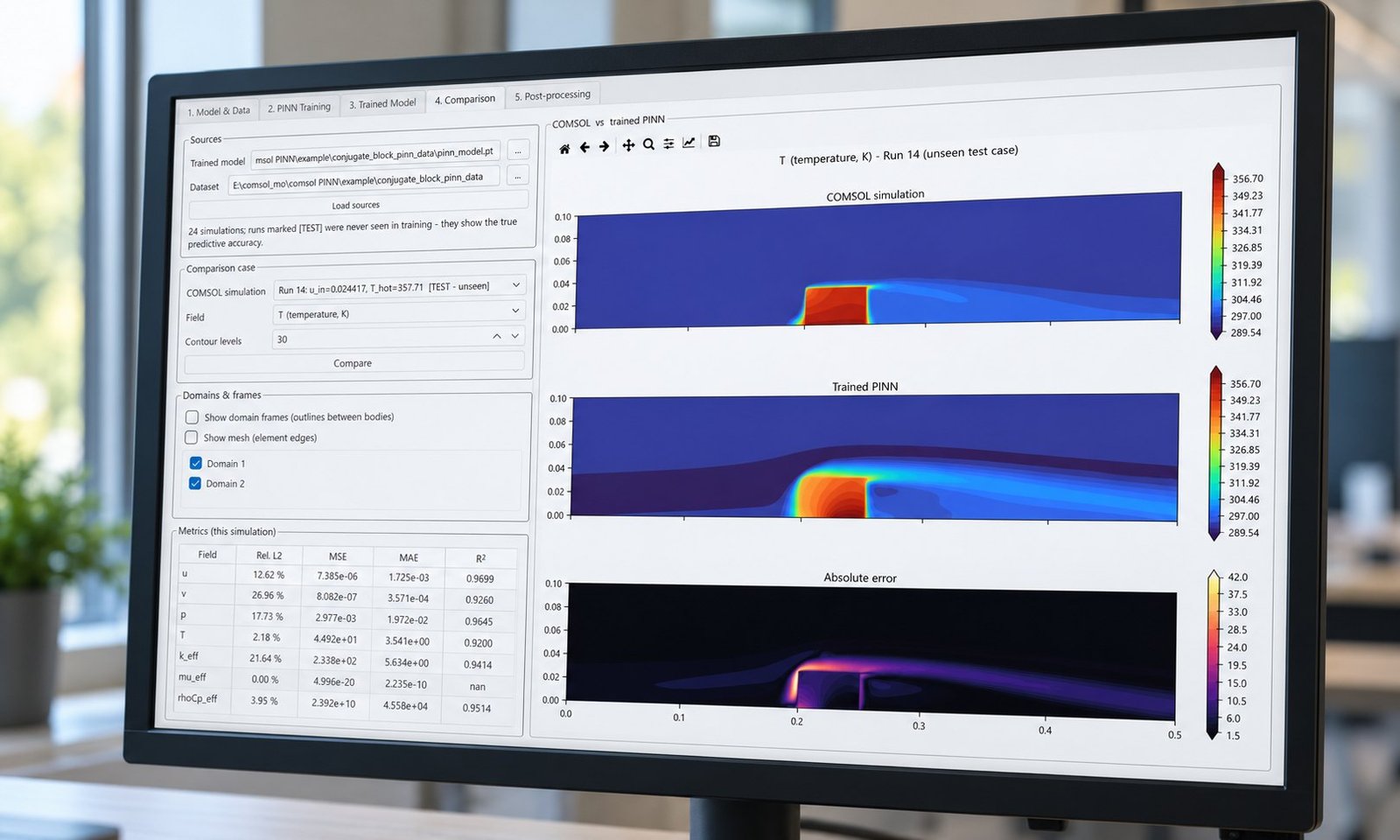
The comparison workflow also shows 24 simulations with an unseen test run. For its temperature field, the screen reports relative L2 error of 2.18%, MSE of 44.92 K², MAE of 3.541 K, and R² of 0.9200. The displayed absolute-error scale reaches about 42 K, so the mean error alone does not establish field safety.
Treat solver wall time and surrogate inference latency as mandatory fields in the run manifest. They are not visible in the supplied screen capture, so we do not claim values for them. The same applies to mass, energy, and boundary residuals. A release record should state each residual in physical units, or mark it as unmeasured.
If you need the model-method tradeoff behind this evidence, the site’s cfd ai article covers the PINN use case. For a field-output deployment record, use the narrower surrogate modelling cfd guidance.
How should you test interpolation and envelope edges?
Use two deliberate tests. An interpolation case checks behavior between sampled runs. An edge-of-envelope case checks the highest-risk point still covered by training. Neither test replaces a geometry or boundary-condition audit.
- Select an interior point between sampled parameter values and compare the full field against the high-fidelity solver. Record mean absolute error, maximum absolute error, normalized RMSE or L2 error, and units.
- Select a corner or near-corner point at the permitted parameter limits. Report the same field metrics and identify the voxel, node, or boundary where the maximum occurs.
- Evaluate mass, energy, and boundary residuals. A low temperature error does not pass if inlet mass flow or wall heat flux is inconsistent.
- Compare slices and extrema, not only volume averages. A missed hot spot can disappear in a scalar KPI.
- Stop evaluation when geometry, topology, or boundary conditions move outside the training envelope. That is the failure trigger, not a minor accuracy warning.
For PINN-specific failure patterns, use Why PINNs Fail CFD: A Field Debugging Guide. If you are choosing between architectures for a changing mesh, the pinn cfd comparison is the next relevant check.
Which sampling method fits a sparse CFD design space?
Use Latin-hypercube sampling when solver runs are expensive and the design space is sparse. Use a simple lookup table only for low-dimensional, well-behaved relationships with no more than three inputs. The dataset must cover every operating variable that can alter the field.
For a datacenter model, encode server workload, fan speed, and HVAC setpoint separately. For a COMSOL or TRNSYS case, preserve physical parameter names and units instead of hiding them behind anonymous feature indices. The neighboring cfd software coverage guidance helps audit missing operating regions.
FAQ: 3D field surrogate acceptance
Is a scalar KPI surrogate enough for optimization?
Yes, if the objective and constraints depend only on scalar values. Add a field output when local gradients, hot spots, or residuals can reject the design.
What is the minimum field error report?
Report mean absolute error, maximum absolute error, normalized RMSE or L2 error, units, the location of the maximum, and separate interpolation and edge-case results.
When must you stop trusting the surrogate?
Stop when geometry, topology, material state, or boundary conditions fall outside the training envelope. Retraining or a high-fidelity solver is required.
Specify the field before you train
A 3D surrogate model earns acceptance by preserving the field that drives the decision, not by producing a fast average. Define the mesh, units, boundary coverage, DOE, residuals, and held-out tests first. For the next implementation step, see AI CFD surrogate modeling for engineering workflows.