
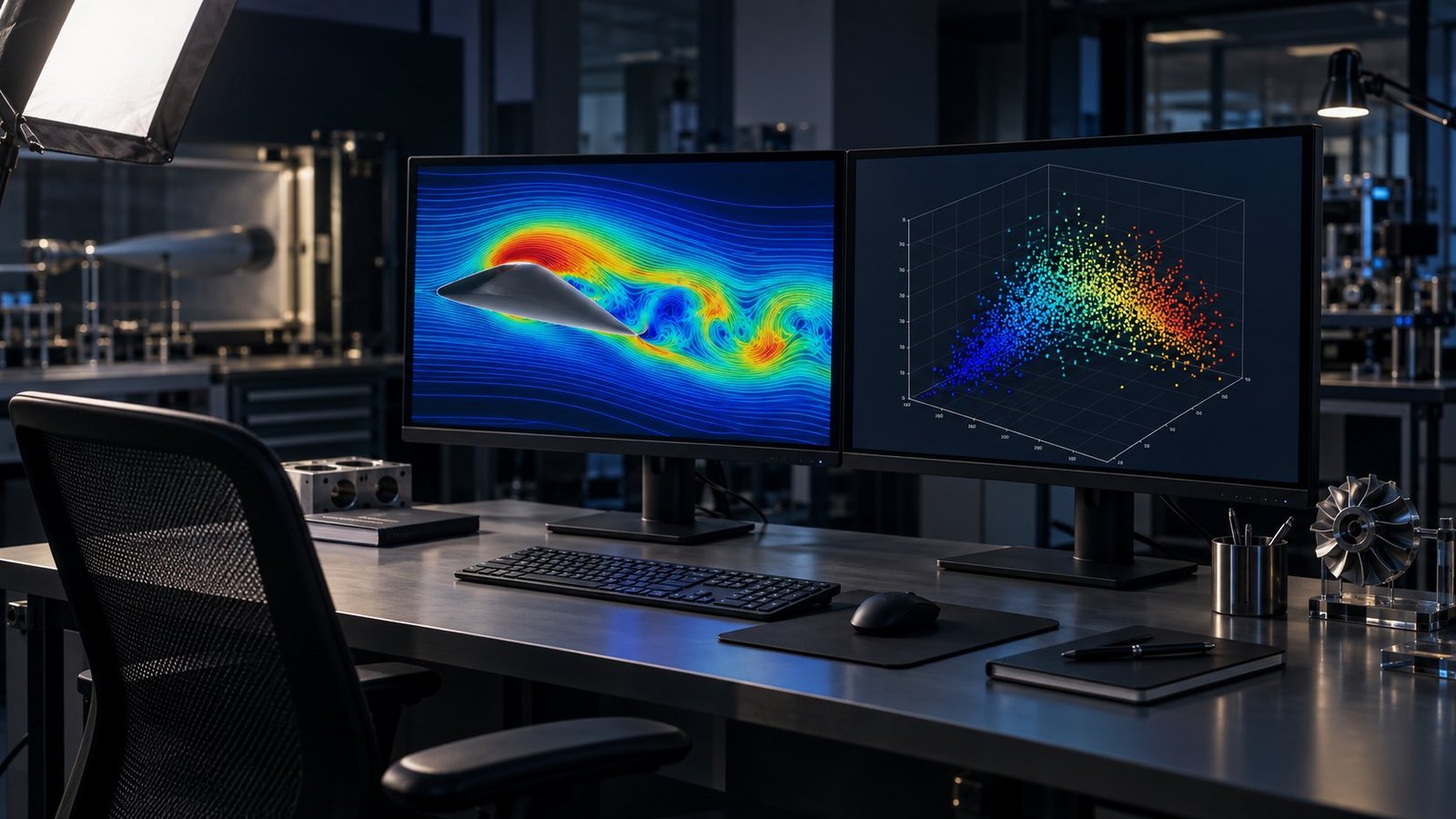
AI for CFD analysis generalizes only across the design space represented by its CFD cases. Before trusting a surrogate, define every geometry and operating input with units and bounds, sample the interior and boundaries, hold out complete cases rather than mesh cells, and run new CFD whenever the proposed point leaves that envelope.
That is the gap left by many ranking pages. Energent.ai emphasizes tools for extracting insight from unstructured CFD files, while Konio Engineering Lab focuses on AI assistance around simulation workflows. This article addresses the numerical dataset decision: whether your CFD cases actually cover the designs you want to evaluate.
How do you define the AI CFD design space?
Define the AI CFD design space as a bounded list of dimensional inputs, not as a collection of solver files. Each input needs a name, unit, minimum, maximum, allowed geometry behavior, and intended use. Separate variables that change geometry from variables that change only the operating point.
- Geometry inputs — dimensions, clearances, angles, positions, and discrete topology choices.
- Operating inputs — inlet velocity, mass flow, pressure, temperature, heat load, and material properties.
- Output fields — velocity, pressure, temperature, concentration, or other fields used by your design decision.
- Derived outputs — pressure drop, peak temperature, heat-transfer rate, flow imbalance, or objective values.
Do not treat a dense mesh as broad data coverage. Five million cells in one case describe one parameter combination. They do not replace cases at the minimum, maximum, boundary combinations, or important transitions in behavior.
How much CFD AI training data should you generate?
There is no universal case count. Use a design of experiments that covers the declared range, then reserve complete CFD cases for validation and testing. A small dataset can work for a smooth, low-dimensional problem. It can fail badly when geometry, flow regime, and thermal boundary conditions interact.
- Write the input register before running CFD. Failure mode: an unlisted boundary condition changes the physics without changing the model version.
- Set inclusive minimum and maximum values for every input. Failure mode: the surrogate receives a unit-converted value outside the range and returns a plausible-looking field.
- Use Latin hypercube, Sobol, or another documented DOE to cover the interior. Failure mode: clustered random points leave holes between important operating limits.
- Reserve boundary and combined-corner cases before training. Failure mode: the model performs well near the center but fails when two limits occur together.
- Store cases by geometry and operating point, not by individual sampled cells. Failure mode: cells from one CFD solution leak into training and testing, overstating generalization.
What does Siemens’ 2026 F1 example teach?
Siemens’ 2026 F1 example shows why dataset coverage must be reported numerically. The example varies 27 front-wing parameters, runs 60 simulated variants, uses 45 cases for training, 5 for validation, and 10 for testing, and represents each case with approximately 5 million surface cells.
| Reported item | Value | Coverage decision |
|---|---|---|
| Geometry parameters | 27 front-wing parameters | Covered only inside the declared parameterization |
| Simulated variants | 60 cases | Case count is meaningful only with the parameter bounds |
| Training split | 45 cases | Fit the surrogate |
| Validation split | 5 cases | Select or monitor the model during training |
| Test split | 10 cases | Measure performance on unseen complete cases |
| Surface resolution | Approximately 5 million cells per case | Improves field resolution, but does not expand parameter coverage |
Siemens also says PhysicsAI can reuse historical CFD and DOE results. That can reduce new solver work, but only if the older cases use compatible geometry definitions, boundary conditions, mesh conventions, and output fields. Rescale’s guidance makes the governing point directly: model reliability depends on coverage of the input space.
The 45/5/10 split is not a rule to copy blindly. It is a reporting pattern. You should publish the split, the case-selection method, and the limits that each split covers. A test set made only from central points does not test the edges where an optimizer often operates.
What did a Multi Optimization COMSOL case actually report?
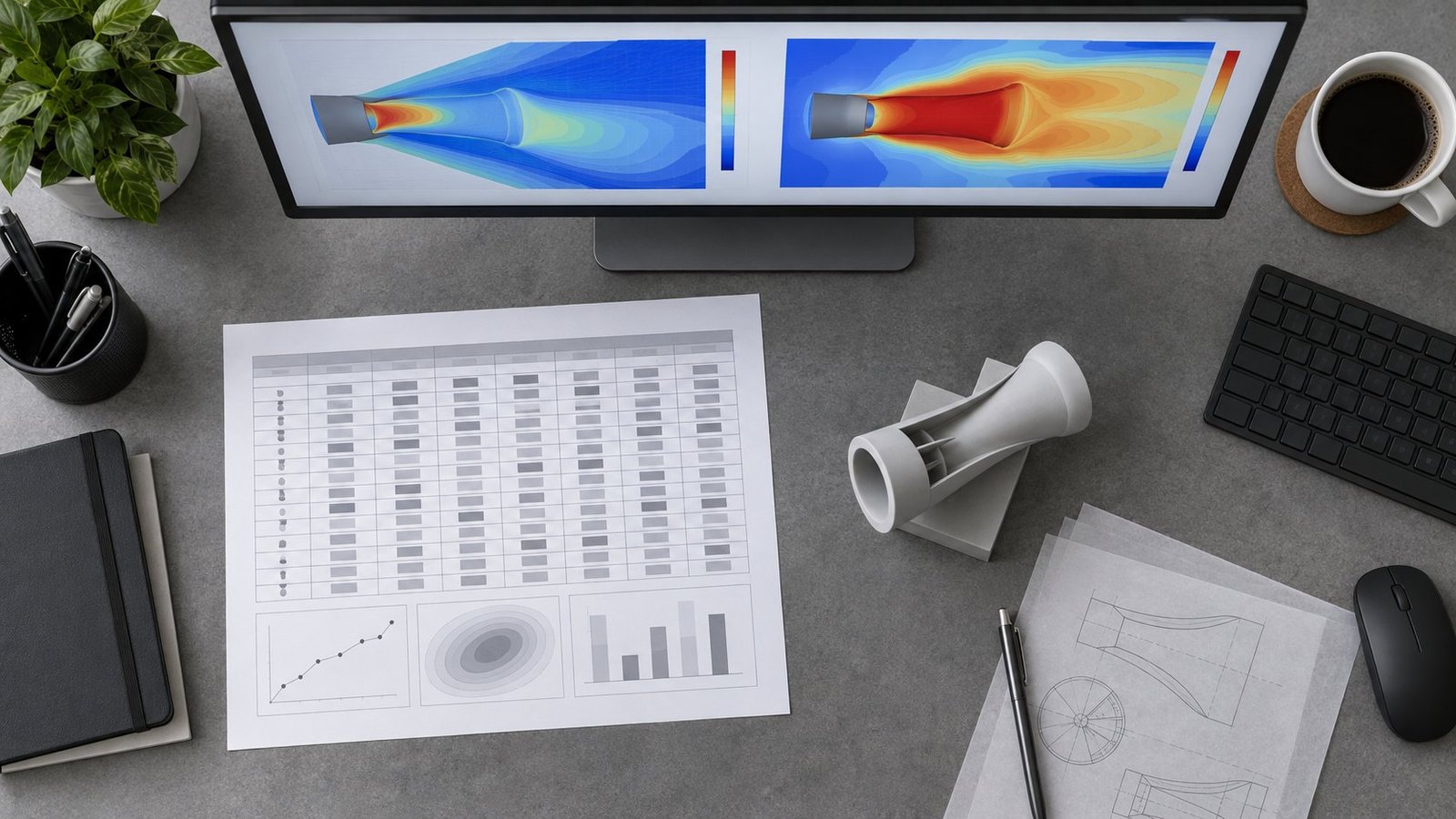
The published Multi Optimization COMSOL example is a full-3D shell-and-tube heat exchanger. It reports 14 solves of an 8-minute RANS model and approximately 2.4% temperature error on the surrogate result. The public case record does not publish the complete input register, numeric bounds, split counts, or an exact inference-time measurement.
That limitation matters. A real COMSOL optimization workflow should not turn missing run-log fields into invented precision. The following table separates what is documented from what remains uncovered in the public record.
| Variable or record item | Unit | Minimum | Maximum | Coverage status |
|---|---|---|---|---|
| Shell-and-tube geometry inputs | Not published | Not published | Not published | Not auditable from the public case record |
| Operating-point inputs | Not published | Not published | Not published | Not auditable from the public case record |
| DOE method | N/A | N/A | N/A | The CFD AI workflow describes Latin hypercube sampling, but the case-specific DOE is not published |
| CFD runs | cases | 14 | 14 | Covered as the reported training campaign |
| Train/validation/test split | cases | Not published | Not published | Held-out testing is reported, but split counts are not |
| Temperature field | °C or K | Not published | Not published | Temperature error of approximately 2.4% is reported |
| Velocity and pressure fields | m/s and Pa | Not published | Not published | Supported by the product workflow, but not separately reported for this case |
| Inference time | ms | Not published | Not published | The product page says milliseconds; exact measured time is not given |
The documented failure mode is straightforward: request a new geometry or operating point outside the trained range and the surrogate can produce a visibly wrong pressure or temperature field. The public case page does not publish a numeric out-of-range error, so treat that failure as a required reproduction test rather than a claimed measurement.
When should you run another CFD case?
Run another CFD case before trusting the surrogate whenever the proposed design is outside a declared input interval, lies in an uncovered boundary combination, introduces a new geometry behavior, or changes a field that the dataset did not represent.
| Check | Covered | Not covered | Decision |
|---|---|---|---|
| Every input has units and bounds | Named, bounded, and unit-checked | Missing range or unit | Run CFD and update the register |
| Operating point | Inside the inclusive trained interval | Below minimum or above maximum | Run CFD or reject the query |
| Geometry | Same parameterized geometry family | New topology, component, or mesh behavior | Run CFD before inference is trusted |
| Boundary combination | Represented by training or held-out cases | Unseen combined extremes | Add a corner or boundary case |
| Output field | Required pressure, temperature, and velocity fields are stored | Decision field is absent or untested | Add the field to the CFD surrogate training dataset |
Use this reproducible rule: calculate a coverage flag for every input and every required output. If any input is outside its inclusive range, if the geometry is outside the parameterized family, if any important boundary or corner lacks a held-out case, or if the requested field is not tested, run another CFD case before accepting the surrogate result.
FAQ: AI for CFD analysis dataset coverage
Is 60 CFD cases enough for 27 parameters?
Not by case count alone. Siemens’ example is useful because it reports the parameter count, case count, split, and field resolution together. You still need the bounds and DOE layout to judge coverage.
Should test cases be sampled from mesh cells?
No. Hold out complete CFD cases. Sampling cells from the same solution in both sets measures field interpolation, not generalization to a new design.
Can historical CFD replace new DOE runs?
Only when the historical cases match the intended geometry, operating ranges, solver assumptions, and output fields. Siemens supports reuse of historical CFD and DOE results, while Rescale emphasizes input-space coverage.
Build the coverage record before trusting the surrogate
A trustworthy CFD dataset states what was varied, how far it varied, which cases were held out, and when another solver run is mandatory. For the complete workflow, see AI CFD surrogate modeling for COMSOL field prediction. Multi Optimization Admin