
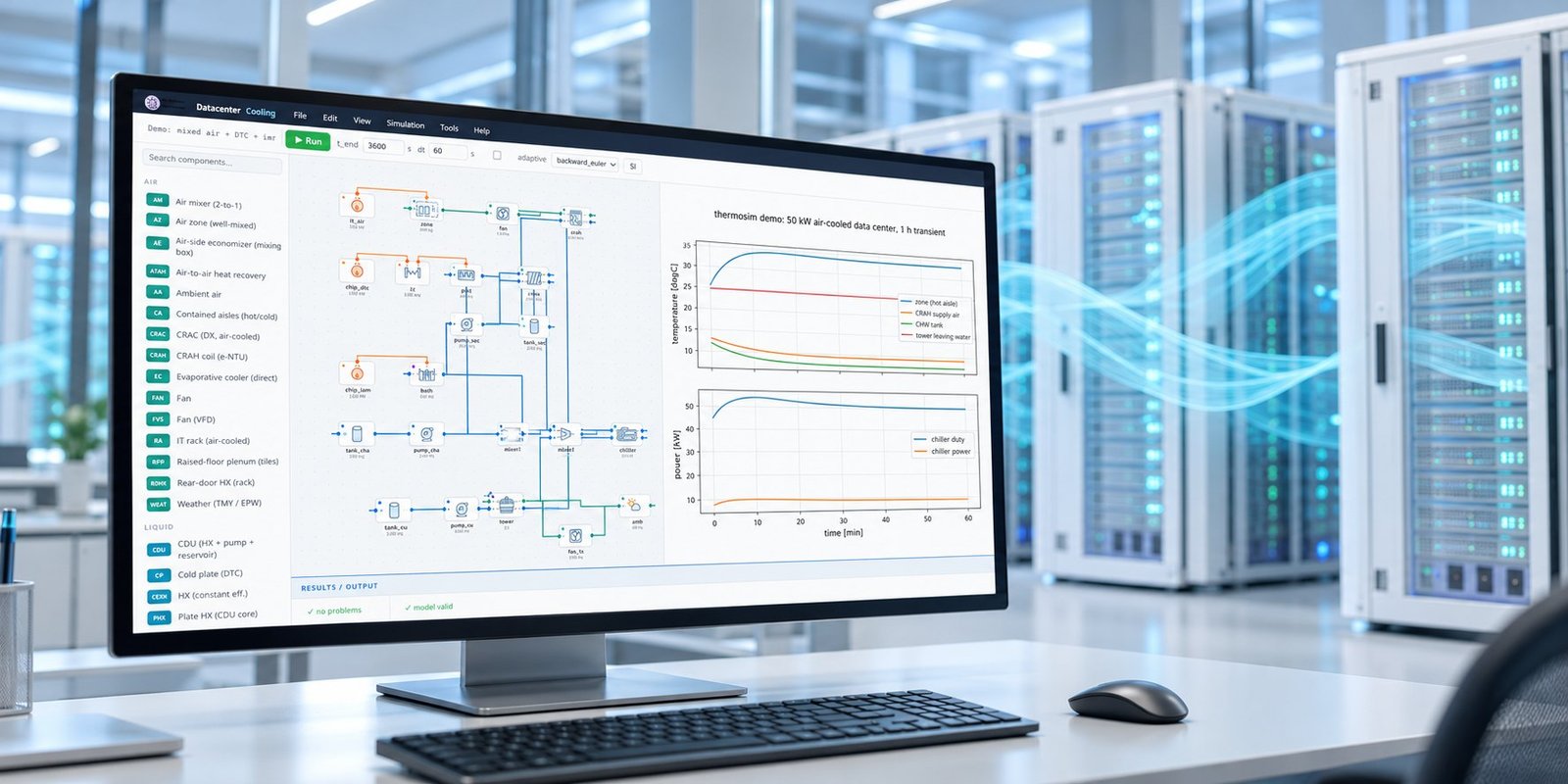
GB300 cooling requirements are a pre-deployment sizing problem, not a single flow number. Start with the rack’s 132 kW nominal TDP, test 25–45°C supply cases against 59–177 LPM, then size CDUs and pumps for rack count and a failed-pump case. Accept the design only when temperature, pressure, and model error pass your limits.
HPE, Lenovo, and Cisco publish the necessary inputs, but their pages leave the engineering decision split across power, CDU, and hydraulic figures. This article reconciles those values into a temperature-dependent model for your rack row, including failure scenarios and simulation acceptance criteria.
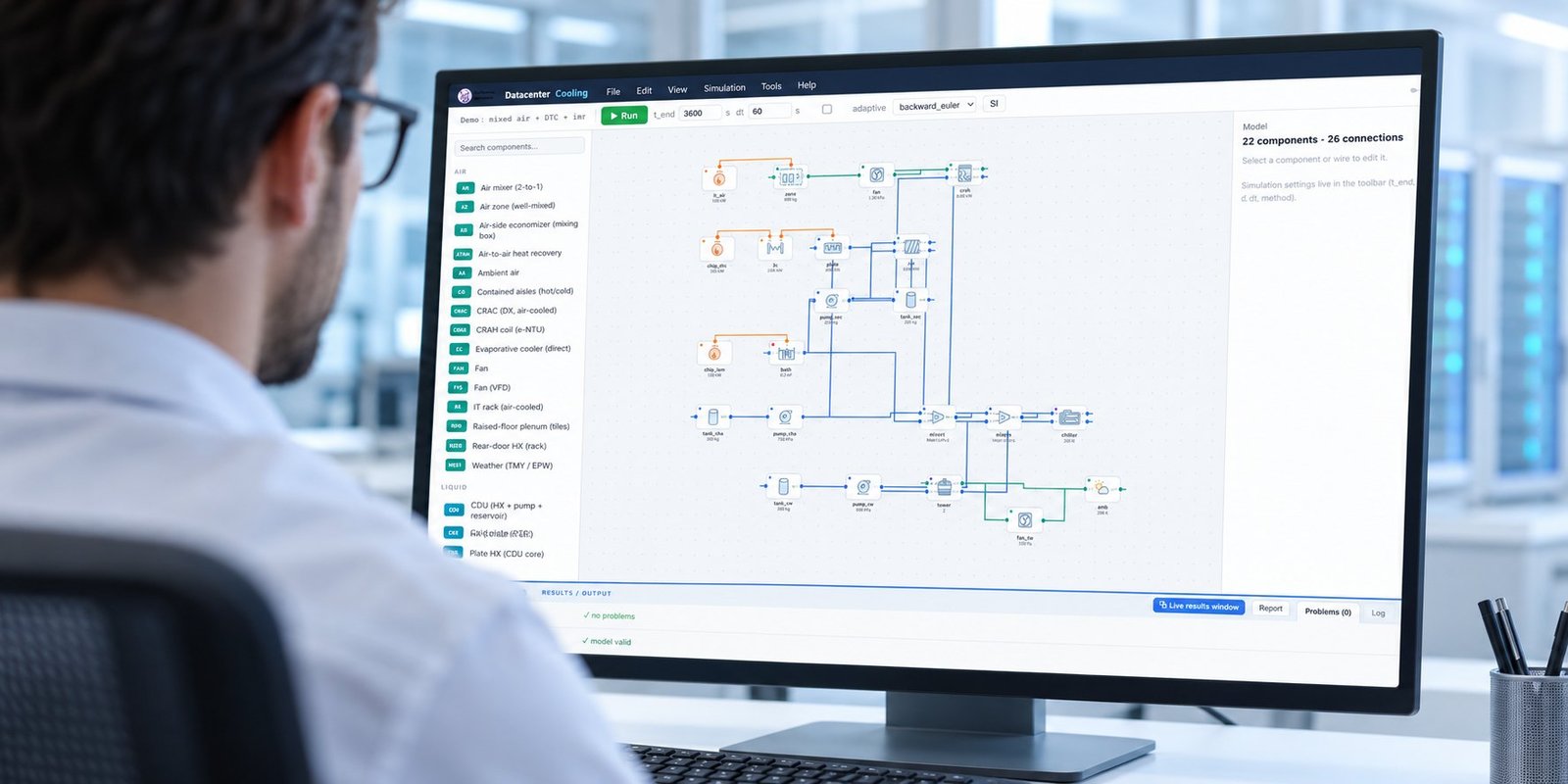
How should you set GB300 cooling requirements before deployment?
Use the rack’s electrical design point as the heat-load boundary, then solve the hydraulic network at several supply temperatures. HPE QuickSpecs identify 72 Blackwell Ultra GPUs, 36 Grace CPUs, 132 kW nominal rack TDP, approximately 155 kW EDPp, and a suggested 192 kW busway provision.
That distinction matters. The 132 kW value is a nominal thermal case. The 155 kW value is a higher electrical design point. The 192 kW busway recommendation is a facility provisioning figure. Your cooling model should expose all three rather than silently treating them as the same load.
How does supply temperature change the GB300 NVL72 flow rate?
The Lenovo NVIDIA GB300 NVL72 User Guide shows a steep hydraulic penalty as supply temperature rises. The required GB300 NVL72 flow rate increases from 59 LPM at 25°C to 177 LPM at 45°C, while rack pressure drop rises from 2.3 psi to 18.4 psi.
| Supply temperature | Required rack flow | Rack pressure drop | Use in your model |
|---|---|---|---|
| 25°C | 59 LPM | 2.3 psi | Low-temperature design reference |
| 30°C | 71 LPM | 3.2 psi | Intermediate sensitivity case |
| 35°C | 89 LPM | 4.9 psi | Balanced design-point case |
| 40°C | 119 LPM | 8.5 psi | High-temperature hydraulic case |
| 45°C | 177 LPM | 18.4 psi | Upper operating-water case |
Do not interpolate only the flow value. Pump head, valve authority, CDU heat-exchanger approach, and manifold losses also change the feasible operating point. The 45°C case requires three times the 25°C flow and almost eight times the listed rack pressure drop.
Which CDU options fit Blackwell Ultra rack cooling?
Blackwell Ultra rack cooling requires a CDU choice tied to rack count, heat load, and failure reserve. HPE lists the Vertiv XDU1350 at 1.3 MW with a maximum of eight racks, while Cisco lists in-rack, in-row, and liquid-to-air alternatives.
| Option | Published capacity | Use when | Model check |
|---|---|---|---|
| Vertiv XDU1350 in-row CDU | 1.3 MW; maximum eight racks | Your row uses HPE’s listed CDU arrangement | Check 132 kW, 155 kW, and failed-pump cases per rack |
| Cisco in-rack CDU | Up to 250 kW | You need rack-local distribution | Test local pump head and isolation behavior |
| Cisco in-row CDU | Up to 1.8 MW | Several racks share a row-level plant | Sweep rack count and CDU availability |
| Cisco liquid-to-air sidecar | Up to 200 kW | The facility lacks a suitable primary liquid loop | Include air-side ambient and fan failure cases |
For NVL72 CDU sizing, do not divide CDU nameplate capacity by nominal rack TDP and stop. Eight racks at 132 kW consume 1.056 MW. Eight racks at approximately 155 kW consume 1.24 MW. Eight racks at the suggested 192 kW busway provision would reach 1.536 MW, above the 1.3 MW CDU rating.
What should your NVL72 CDU sizing model sweep?
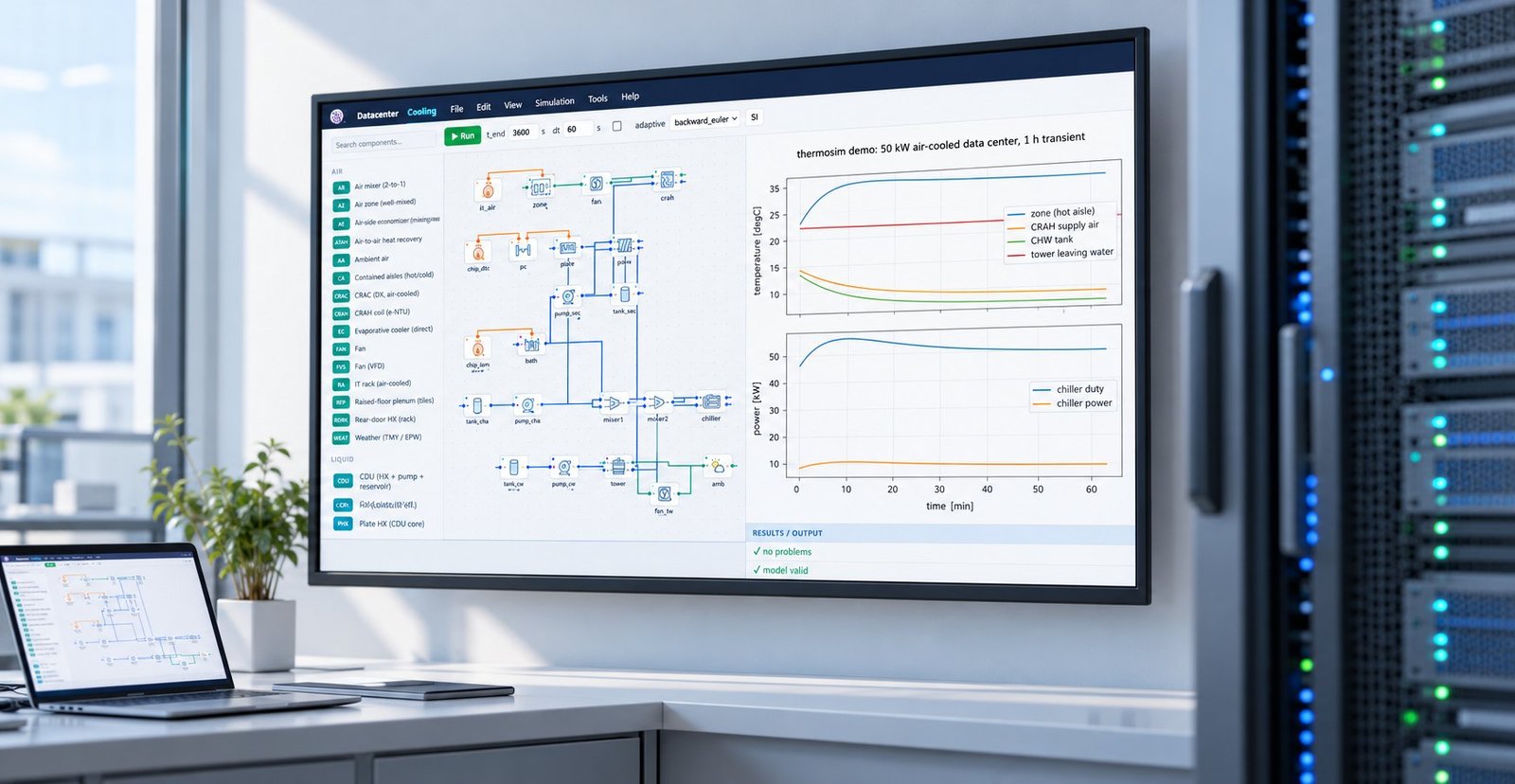
Your internal model should sweep supply temperature, rack flow, CDU count, rack count, and pump failure together. Multi Optimization uses thermosim-model 0.1 with SI units, backward Euler integration, a 3,600-second transient, and a 60-second timestep for this screening workflow.
- Set the heat-load cases at 132 kW nominal and approximately 155 kW EDPp. Failure mode: an undersized thermal boundary hides CDU saturation.
- Sweep 25°C, 30°C, 35°C, 40°C, and 45°C supply conditions using Lenovo’s flow and pressure points. Failure mode: a fixed-flow assumption understates pump head at high temperature.
- Vary rack count from one to eight and CDU count across the available plant arrangement. Failure mode: a shared CDU can exceed its capacity before any single rack appears overloaded.
- Remove one duty pump and recompute flow, pressure, outlet temperature, and CDU approach. Failure mode: loss of redundancy can create a thermal excursion even when the healthy case passes.
- Run NSGA-II with a population of 64 for 40 generations, minimizing maximum rack temperature, flow shortfall, pressure drop, and CDU count. Failure mode: optimizing only energy or equipment count produces an infeasible hydraulic design.
One internal reference run used one rack, one CDU, 132 kW load, 35°C supply, and healthy pumps. The model returned 88.6 LPM and 4.85 psi. Against Lenovo’s 89 LPM and 4.9 psi reference, the validation errors were 0.45% for flow and 1.02% for pressure.
For reduced-order studies, a cfd ai model can screen more combinations before you run the detailed network. Use Why PINNs Fail CFD: A Field Debugging Guide when the surrogate misses sharp pump or valve transitions. A pinn cfd comparison helps when transient fidelity matters. Your cfd software dataset audit should include every temperature and failure branch used for acceptance.
How do you accept the design before deployment?
Accept the design only when the healthy and failed-pump cases meet your thermal, hydraulic, and validation gates. A practical project baseline is ±0.5°C supply control, flow within ±5% of the selected reference, pressure within ±10%, heat balance within ±3%, and no rack temperature excursion during the defined pump-failure interval.
Lenovo identifies a 2–50°C operating-water range as ASHRAE W45 compliant for the NVLink switch tray. Treat W45 as the cited operating-water class, not a complete site acceptance guarantee. Your commissioning plan still needs fluid chemistry, cleanliness, leak detection, condensation control, CDU alarms, isolation logic, and pump-restart behavior.
GB300 cooling requirements: frequently asked questions
What is the design flow at 35°C?
The Lenovo NVIDIA GB300 NVL72 User Guide lists 89 LPM and 4.9 psi rack pressure drop at 35°C supply.
Is an 8-rack CDU automatically sufficient?
No. HPE lists eight racks as the maximum for its 1.3 MW CDU, but your aggregate heat case, flow, reserve, and failure scenario still need to pass.
Does ASHRAE W45 approve the whole site?
No. W45 describes an operating-water class. Site acceptance also depends on fluid quality, controls, condensation risk, leak response, and verified hydraulic performance.
Turn GB300 cooling requirements into a deployment decision
Use the HPE power boundary, Lenovo hydraulic table, and Cisco CDU alternatives as model inputs—not as isolated sizing answers. Sweep temperature, flow, rack count, CDU count, and pump failure before equipment arrives. Then document the result with measured units, validation error, and acceptance limits. For the next modeling layer, use AI CFD surrogate modeling for cooling studies to reduce repeated CFD runs while preserving the cases that control deployment.