
Data center cooling software should test whether your air-cooled hall can accept a high-density rack before you approve facility changes. Model rack thermal load, cooling-unit capacity, electrical power, heat rejection, retrofit complexity, and failure recovery together. The result is a Pareto set showing which 60 kW designs retain thermal headroom at acceptable energy and cost.
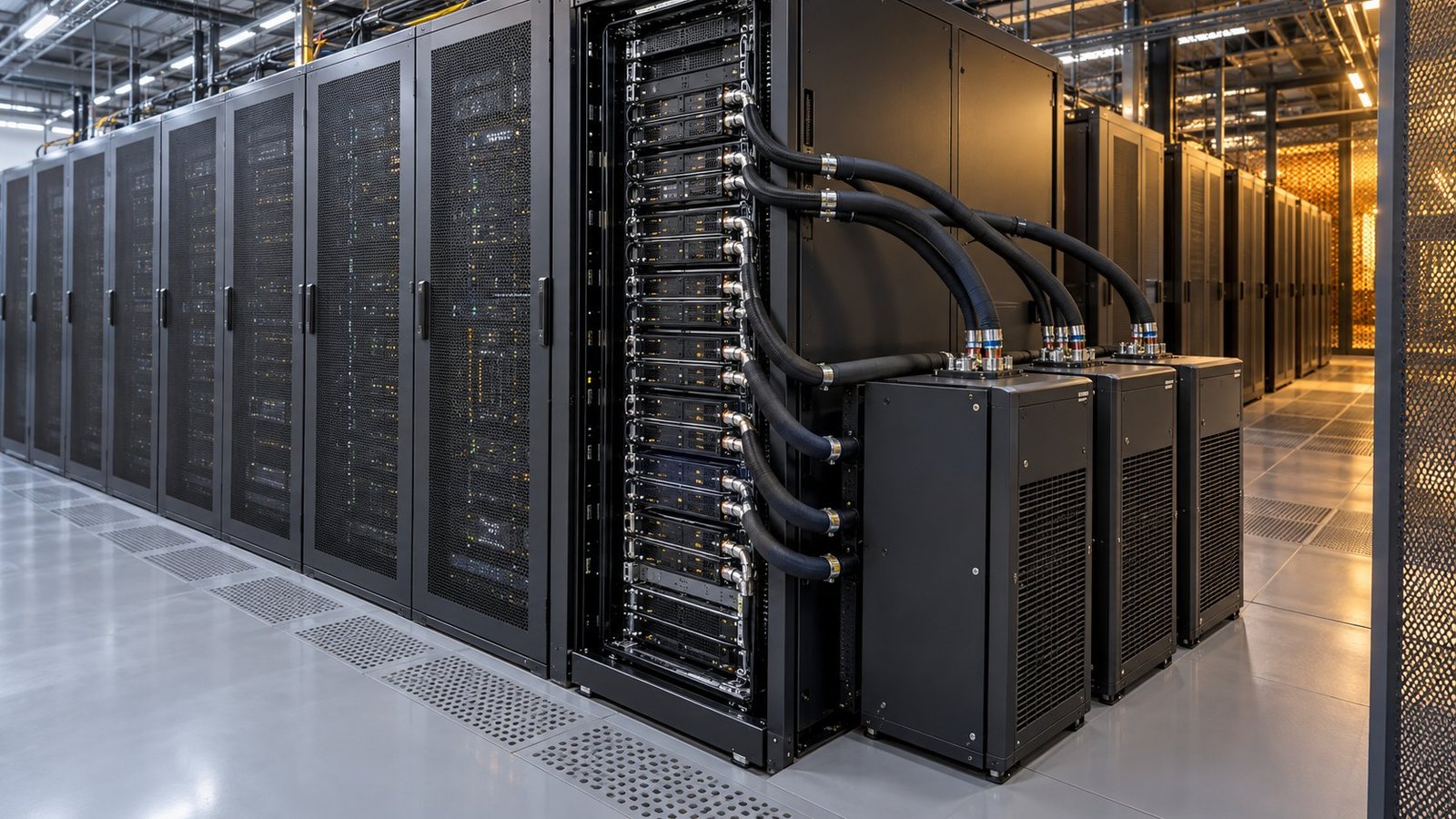
Google Cloud’s June 17, 2026 Brazos release makes this decision concrete. Brazos supports a 60 kW nominal rack load through three cooling units occupying 11 Open Units. It accepts DI water or PG25, uses 40–60 V DC, exposes Modbus TCP, and includes leak detection, pressure relief, and hot-swappable pumps and fans. Uptime Institute’s 2026 Cooling Systems Survey, based on 1,034 respondents, confirms that direct liquid cooling is now a mainstream buyer question.
Why does data center cooling software need a retrofit model?
A retrofit model answers a narrower question than a software directory or general cooling guide: can this rack, in this hall, operate within measurable thermal, electrical, control, and recovery limits? SocialAtz’s data center cooling software category and TrustRadius’s enterprise cooling listings help you find products, but they do not test a specific rack architecture against those constraints.
You need a coupled screening model. A rack can fit mechanically and still fail because the busbar cannot supply the required DC power, the hot aisle cannot reject added heat, or one unavailable cooling unit leaves too little capacity. Multi Optimization combines system simulation and detailed thermal models so you can reject weak retrofit candidates before field installation.
What should your AI rack cooling design screen?
Your AI rack cooling design should screen six constraints at the same time. Treat each one as a variable or limit in the optimization model, not as a late-stage checklist item.
| Constraint | Screening input | Decision limit | Use when |
|---|---|---|---|
| Rack thermal load | Nominal and transient IT heat in kW | Keep predicted component temperature below your verified limit | Comparing accelerator populations and utilization profiles |
| Cooling-unit or CDU capacity | Three-unit capacity, flow, coolant, and redundancy state | Maintain headroom after one unit is unavailable | Testing N, N+1, and degraded operation |
| Electrical power | 40–60 V DC input, busbar rating, pump and fan demand | Stay below rack and branch power limits | Checking whether the hall can host the rack without new distribution |
| Ambient heat rejection | Hot-aisle temperature, airflow, and room operating point | Reject total heat without exceeding room limits | Evaluating summer conditions and partial fan availability |
| Retrofit complexity | 11 Open Units, manifold work, controls, and installation sequence | Minimize removed rack space and field changes | Ranking one-rack-at-a-time deployment plans |
| Failure recovery | Leak, low-flow, pump, fan, and Modbus alarm states | Reach a defined safe state within the recovery window | Writing commissioning and operating procedures |
For Brazos, encode the three cooling units and 11 Open Units as real geometry and capacity constraints. Encode DI water and PG25 as separate coolant cases. Treat 40–60 V DC as an operating range, not a nominal label. Include Modbus TCP points for status and alarms so the model reflects the control path your operators will use.
Can a 60 kW rack operate in an air-cooled hall?
A 60 kW rack can operate in an air-cooled hall when the rack-side liquid system removes the component heat and the room can reject the remaining heat load. Brazos is designed for that arrangement: its closed internal liquid loop transfers heat to liquid-to-air heat exchangers that discharge into the hot aisle.
Do not treat the 60 kW figure as a guarantee for every room. Test the hot-aisle temperature at the worst seasonal condition, the available fan capacity, and the interaction with neighboring racks. Your model should also separate nominal operation from degraded operation. A 60 kW rack with one cooling unit unavailable may have a different safe limit than the installed nameplate suggests.
The electrical case deserves equal attention. At 40–60 V DC, the same rack power produces different current levels, so busbar and protection losses change across the operating range. Include pump and fan power in the rack budget. A thermal design that passes on IT load alone can fail the available electrical power constraint.
How do you sequence the retrofit and test failure recovery?
Use a one-rack sequence with an explicit failure trigger at every gate. Google Cloud describes Brazos as a rack-mounted system intended for installation in existing air-cooled environments, while its hot-swappable pumps and fans support field serviceability. Your commissioning plan still needs measurable abort and recovery conditions.
- Baseline the hall at the target ambient condition. Failure trigger: hot-aisle temperature or branch power already exceeds the modeled operating limit.
- Install the rack-side cooling units, manifold, sensors, and DC connection. Failure trigger: the 11 Open Unit allocation, service clearance, or busbar rating does not match the design model.
- Fill and verify the selected DI water or PG25 loop. Failure trigger: leak detection trips, pressure relief behavior is abnormal, or measured flow remains below the verified minimum.
- Connect Modbus TCP monitoring and validate alarms against the control system. Failure trigger: loss of communications prevents a defined safe response.
- Run the rack at nominal and transient load. Failure trigger: predicted or measured component temperature crosses the thermal limit, or hot-aisle heat rejection exceeds the room limit.
- Remove one cooling unit or simulate its unavailable state. Failure trigger: remaining capacity cannot hold the rack at the degraded operating limit.
- Restore service and record recovery time. Failure trigger: a hot-swappable pump or fan replacement does not return flow, pressure, and temperature to the validated envelope.
The critical trigger is often low flow, not total system shutdown. Define the verified minimum flow from your rack and coolant model, then test the alarm margin above that value. Also test one cooling unit unavailable. Those two cases expose whether your design has real recovery capacity or only nominal capacity.
What does a parallel optimization study produce?
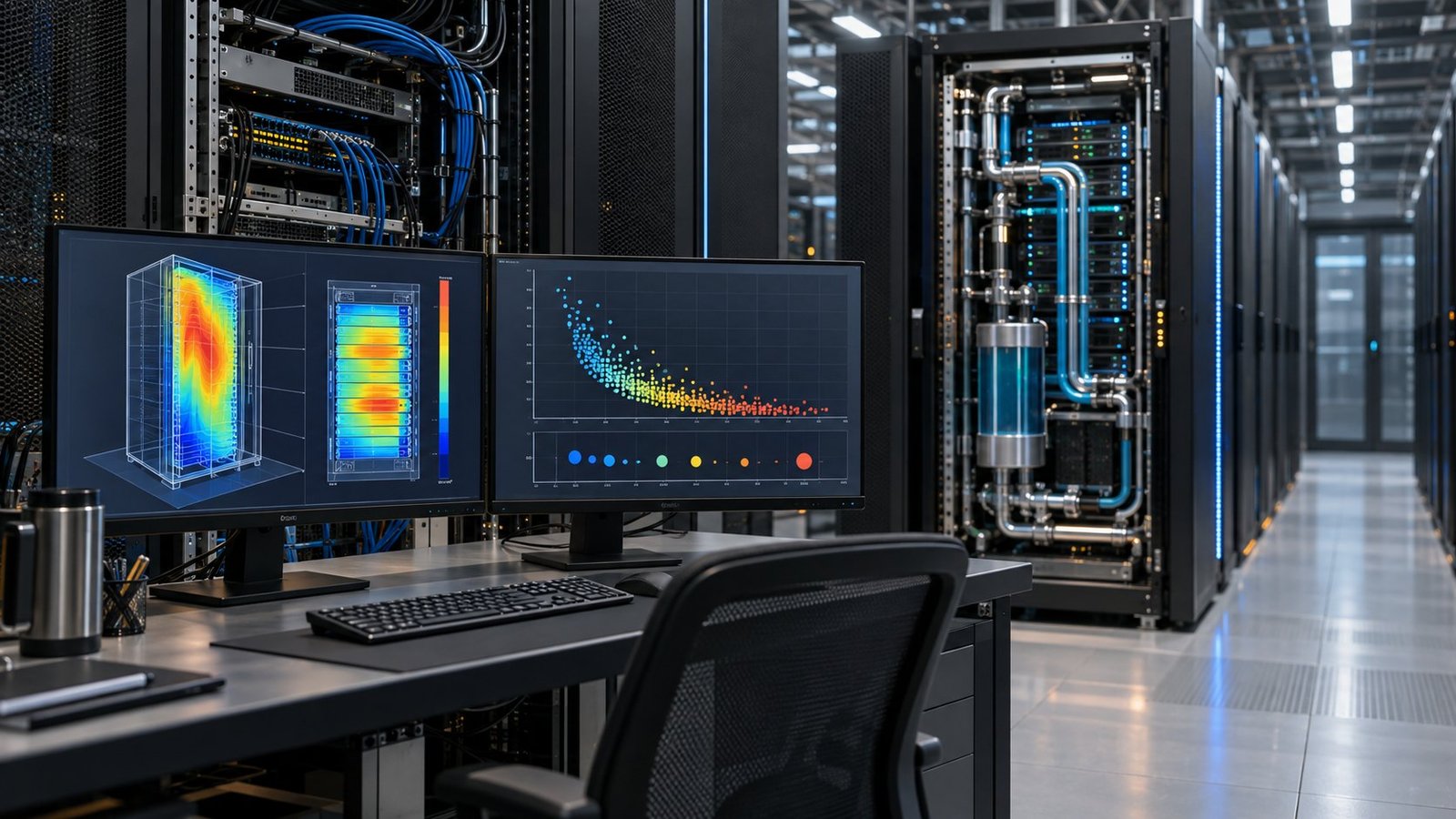
Multi Optimization runs a parallel multi-objective study across TRNSYS, EES, and COMSOL. The objectives are thermal headroom, energy use, retrofit complexity, and cost. Instead of returning one forced answer, the study returns a Pareto set so you can compare a cooler design against a simpler or lower-power design.
A representative NSGA-II screening run evaluated 1,024 candidate designs in 31 minutes 12 seconds with eight parallel workers. The equivalent serial run took 3 hours 44 minutes, giving a 7.2× wall-clock speedup. The maximum predicted component temperature in the retained Pareto set was 78.4 °C. Record the solver versions, worker count, convergence settings, and boundary conditions with that result.
Use TRNSYS Optimization for hall-level energy and ambient-condition cases, EES Optimization for fluid, pressure, and power calculations, and COMSOL Optimization for component and manifold thermal detail. An AI surrogate can screen additional candidates after the high-fidelity runs establish the valid range.
FAQ: data center cooling software for rack retrofits
What is the first number to verify for a 60 kW rack?
Verify the actual rack thermal load profile, not only the nominal 60 kW rating. Include utilization transients, pump and fan power, and the remaining cooling capacity after one unit is unavailable.
Does PG25 change the screening model?
Yes. PG25 changes fluid properties, pumping demand, and heat-transfer behavior compared with DI water. Run both coolant cases with the same rack load and ambient boundary conditions.
What should trigger a safe-state response?
Use low flow below the verified minimum, leak detection, abnormal pressure, loss of Modbus TCP monitoring, or one unavailable cooling unit as explicit triggers. Define the resulting load reduction or shutdown before commissioning.
Make the retrofit decision before installation
The practical question is not whether liquid cooling can support a 60 kW rack. It is whether your existing hall can support that rack across nominal, ambient, electrical, control, and failure states. Use a Pareto study to show the trade-off between thermal headroom, energy, retrofit complexity, and cost. For the full workflow, see our rack-mounted liquid cooling retrofit screening with data center cooling simulation.