
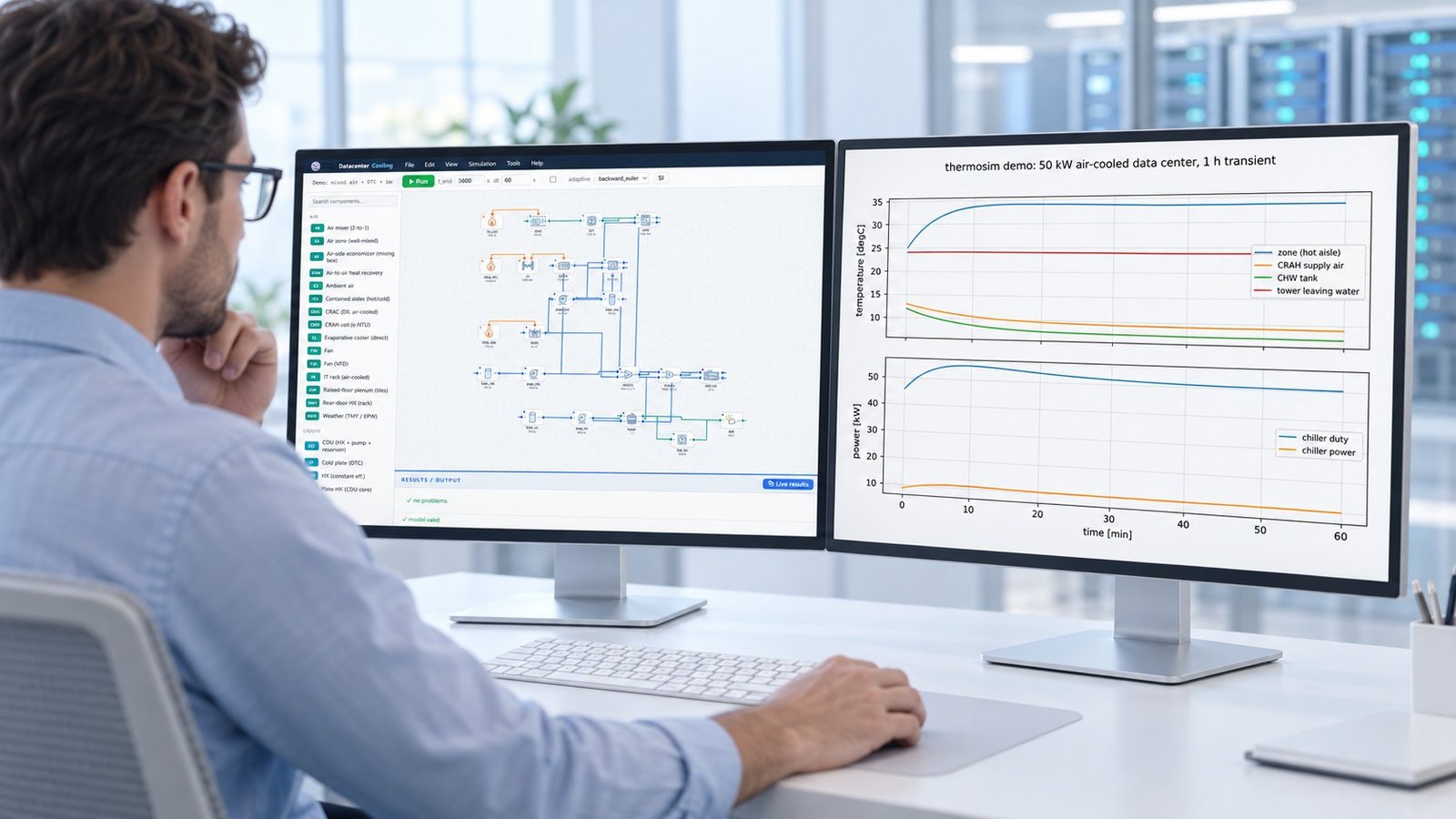
CDU approach temperature is the difference between technology cooling system supply and facility water supply temperature. Use ATD = TCS supply temperature − FWS supply temperature, then hold duty, fluid, flow, pressure head, and return temperatures constant while sweeping 2, 4, and 5 K. That exposes capacity, pump power, and dry-cooler trade-offs before procurement.
The missing design step is normalization. Product pages define ATD or list isolated ratings, but they rarely show how ATD changes usable CDU capacity, free-cooling potential, and annual plant performance. Multi Optimization Admin uses a reproducible parameter sweep to connect those values to procurement decisions as 45°C-capable products enter the market.
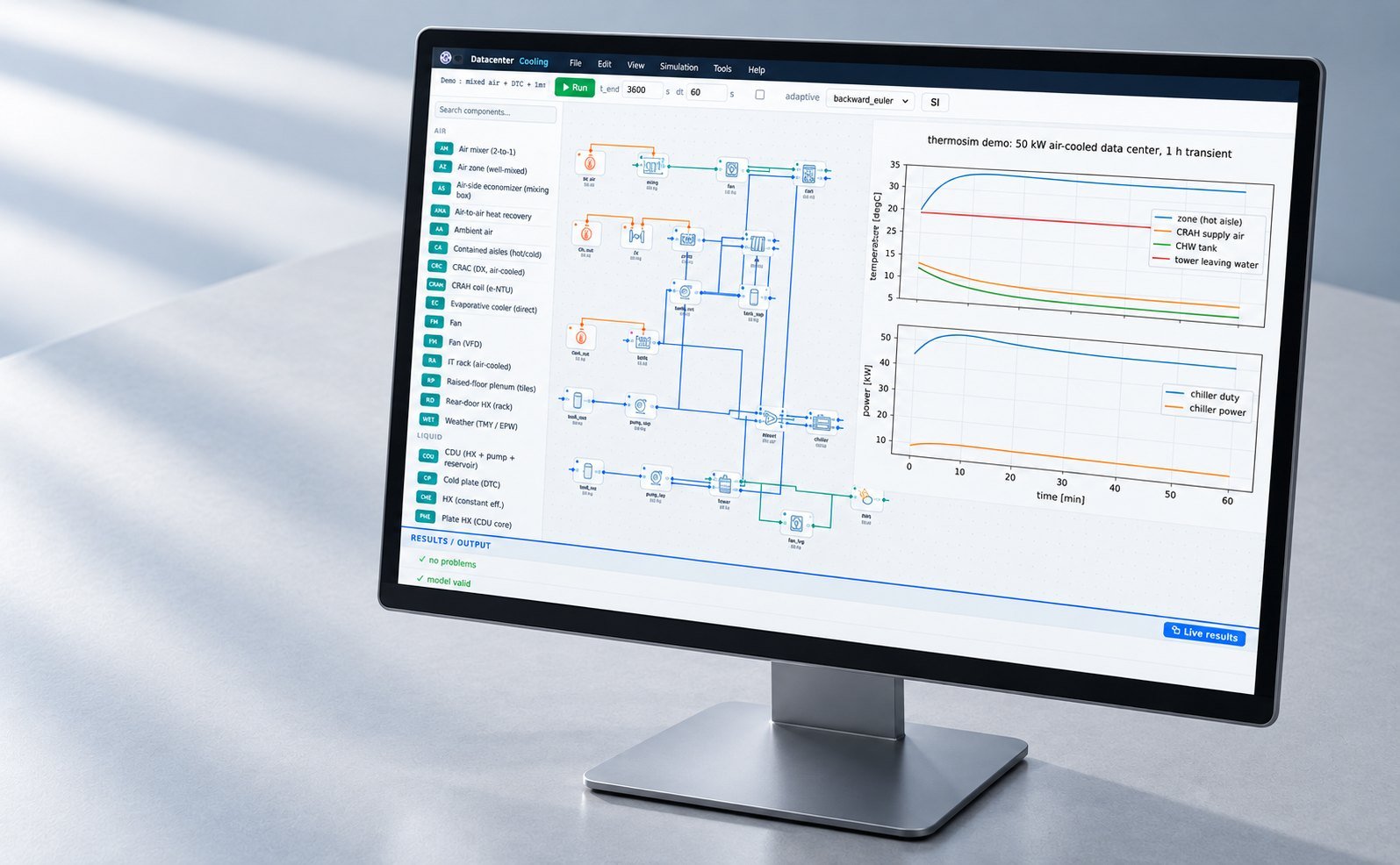
How do you calculate CDU approach temperature?
Use the Open Compute Project Liquid to Liquid CDU Test Methodology and Performance Rating, Revision 1.0, §3.3.2.1: ATD equals TCS supply temperature minus FWS supply temperature. If the catalogue pair is TCS 44/32°C and FWS 30/40°C, the supply nodes are 32°C and 30°C, so ATD = 2 K.
Treat heat exchanger approach as a node-to-node calculation, not as the difference between both listed temperature pairs. The same OCP document, §3.3.2.4, recommends reporting fluid type, FWS temperature or ASHRAE water class, flow rate, pressure head, and ATD together.
Which temperature and flow inputs belong in the model?
- TCS supply and return temperatures at the CDU boundary.
- FWS supply and return temperatures at the facility boundary.
- Fluid type, concentration, and the selected ASHRAE water class.
- Technology cooling system flow, pressure head, pump efficiency, and control limits.
- Rack or load-side duty, design ambient, and dry-cooler enable temperature.
See also: TRNSYS Energy System Simulation Explained
How should you normalize CDU vendor ratings?
Normalize every rating to the same duty, supply and return temperatures, fluid, flow, pressure head, and CDU approach temperature. Use the data center cooling load rule of thumb only to bound the first run; replace that estimate with your rack-load profile before selecting equipment.
| Source or product | Published rating | What the rating does not prove | Use when |
|---|---|---|---|
| Daikin Data Center Solutions Product Catalogue | 400, 1,000, and 2,000 kW CDU sizes; TCS 44/32°C; FWS 30/40°C; 2 K ATD; 25 µm filtration; IE5 motor | The listed capacity is not comparable without matching fluid, flow, pressure head, and control conditions | Shortlisting a CDU family at a normalized 2 K duty point |
| Trane Technologies LiquidStack CDU 2.X | Up to 3,750 L/min at 3.5 bar; facility inlet temperatures up to 45°C | Maximum flow, maximum head, and maximum inlet temperature are not one simultaneous thermal duty point | Testing high-temperature facility-water procurement cases |
| OCP Liquid to Liquid CDU Test Methodology, §3.3.2.4 | Fluid, FWS temperature or ASHRAE water class, flow rate, pressure head, and ATD reported together | A single capacity number cannot reproduce the acceptance condition | Writing a request for quotation or acceptance test |
Trane’s published maximums also give a useful pump-power check. At 3,750 L/min and 3.5 bar, hydraulic power is about 21.9 kW. At 80% pump efficiency, electrical input is about 27 kW. Treat that as an upper-bound calculation, not as a guaranteed operating point.
See also: Data Center Cooling Load Calculation: Static or Transient?
How does ATD change usable CDU capacity?
For a fixed TCS supply, higher ATD requires colder facility water. That can reduce free-cooling hours even when a CDU accepts warmer inlet water. For a fixed FWS supply, higher ATD raises TCS supply temperature and can reduce rack-side thermal margin.
The following normalized sweep is a simulated example, not a vendor rating. Conditions are 1,000 kW constant load, water, TCS 44/32°C, 80% pump efficiency, fixed 40°C FWS return, and an 8,760-hour weather file. Dry-cooler hours count when ambient conditions satisfy the modeled FWS supply setpoint.
| ATD | TCS supply | FWS supply | Simulated heat-transfer capacity | Simulated pump power | Annual dry-cooler hours |
|---|---|---|---|---|---|
| 2 K | 32°C | 30°C | 1,000 kW | 58 kW | 3,120 h |
| 4 K | 32°C | 28°C | 950 kW | 51 kW | 2,280 h |
| 5 K | 32°C | 27°C | 925 kW | 48 kW | 1,860 h |
This simulated curve falls from 1,000 kW at 2 K to 925 kW at 5 K, while annual dry-cooler operation falls by 1,260 hours. The result shows why a 45°C facility inlet limit does not replace an ATD study. For retrofit constraints, compare the result with Data Center Cooling Software for AI Rack Retrofits.
What should your CDU specification include?
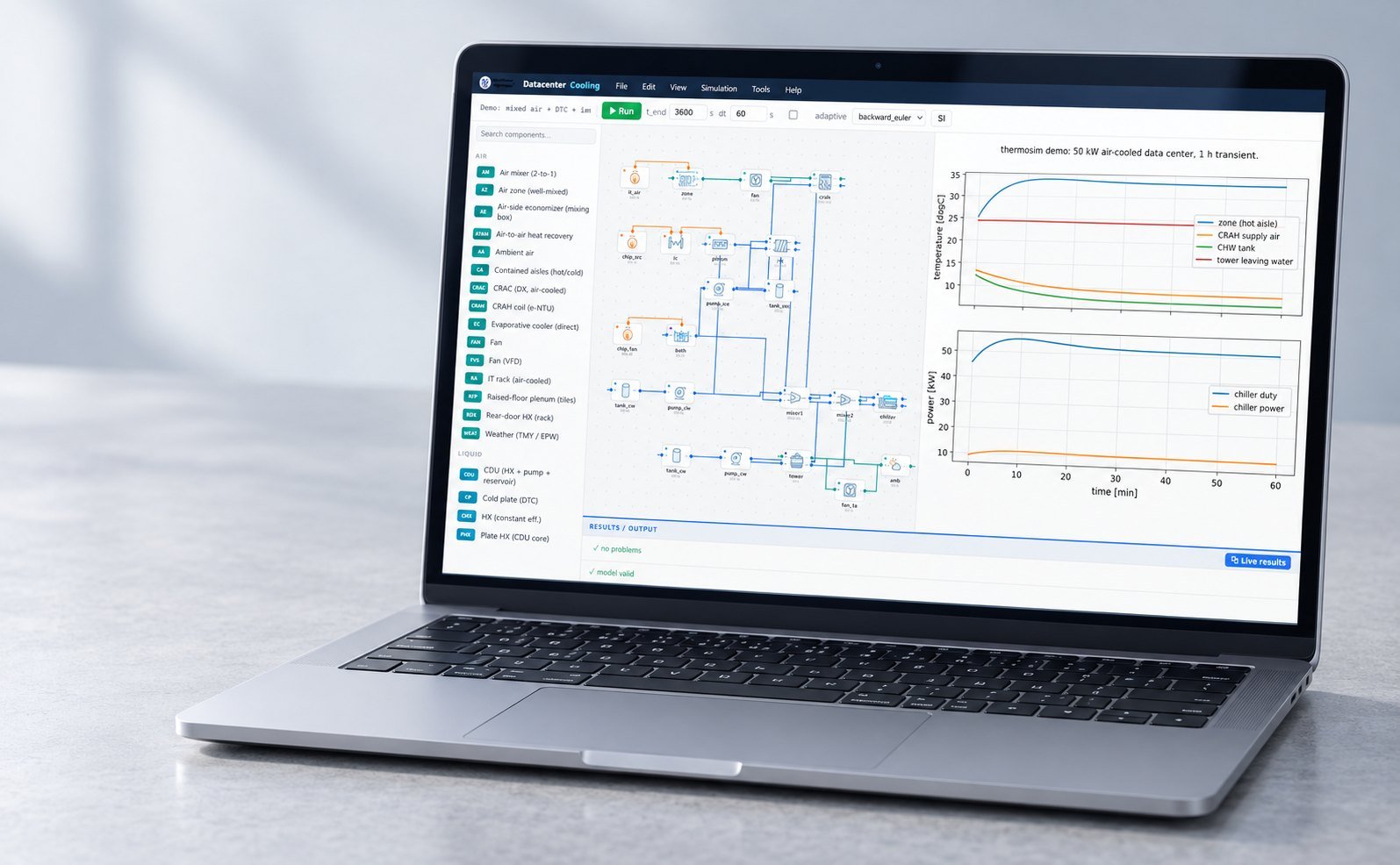
Your specification should define the boundary nodes first, then require the OCP reporting bundle at every candidate duty point. For coolant distribution unit sizing, keep technology cooling system flow and pressure head explicit rather than accepting a capacity number alone.
- Define TCS and FWS supply and return nodes, load duty, fluid, and design ambient. Failure mode: swapping a return temperature into the ATD equation creates a false approach value.
- Normalize vendor data to the same flow, pressure head, filtration, motor efficiency, and water class. Failure mode: comparing a maximum flow rating with a rated thermal duty.
- Run ATD cases at 2, 4, and 5 K and record capacity, pump power, supply temperature, and annual dry-cooler hours. Failure mode: holding pump power constant hides the hydraulic penalty.
- Validate control sequences, alarm limits, and acceptance measurements against the OCP method. Failure mode: a 45°C inlet assumption masks a low-flow or high-head trip.
- Use cfd software or an AI/PINN surrogate model when rack headers, manifolds, or weather scenarios make the full sweep too expensive.
Frequently asked questions about CDU approach temperature
Is a lower ATD always better?
No. Lower ATD can improve TCS-side temperature margin, but it may require colder facility water, higher flow, more pump power, and fewer dry-cooler hours.
Does a 45°C facility inlet rating remove the need for an ATD calculation?
No. The 45°C value is a facility-side operating limit. You still need TCS supply, FWS supply, flow, pressure head, fluid, and ATD at the selected duty point.
What must you report with ATD?
Report fluid type, FWS temperature or ASHRAE water class, flow rate, pressure head, and ATD together, as recommended by OCP §3.3.2.4.
Use ATD to choose the right cooling system
A CDU procurement decision is stronger when the rating is tied to a normalized duty point and an annual plant simulation. Run the 2, 4, and 5 K sweep in your cooling systems for ai data centers study, then test the selected case in a cooling system for your data center workflow. — Multi Optimization Admin
What approach temperature difference should I expect between top-tier L2L CDU solutions for Blackwell?
For a Blackwell design, use 2 K as the target ATD, 3 K as a reasonable procurement boundary, and treat 4 K or higher as a plant-level penalty rather than a normal difference between top-tier CDUs.
Compare candidates at the same duty, flow, fluid, and pressure head. A claimed 0.5 K advantage is not decision-grade unless supply-temperature sensors are calibrated to at least ±0.1 K and the test repeats at three steady-state points.