
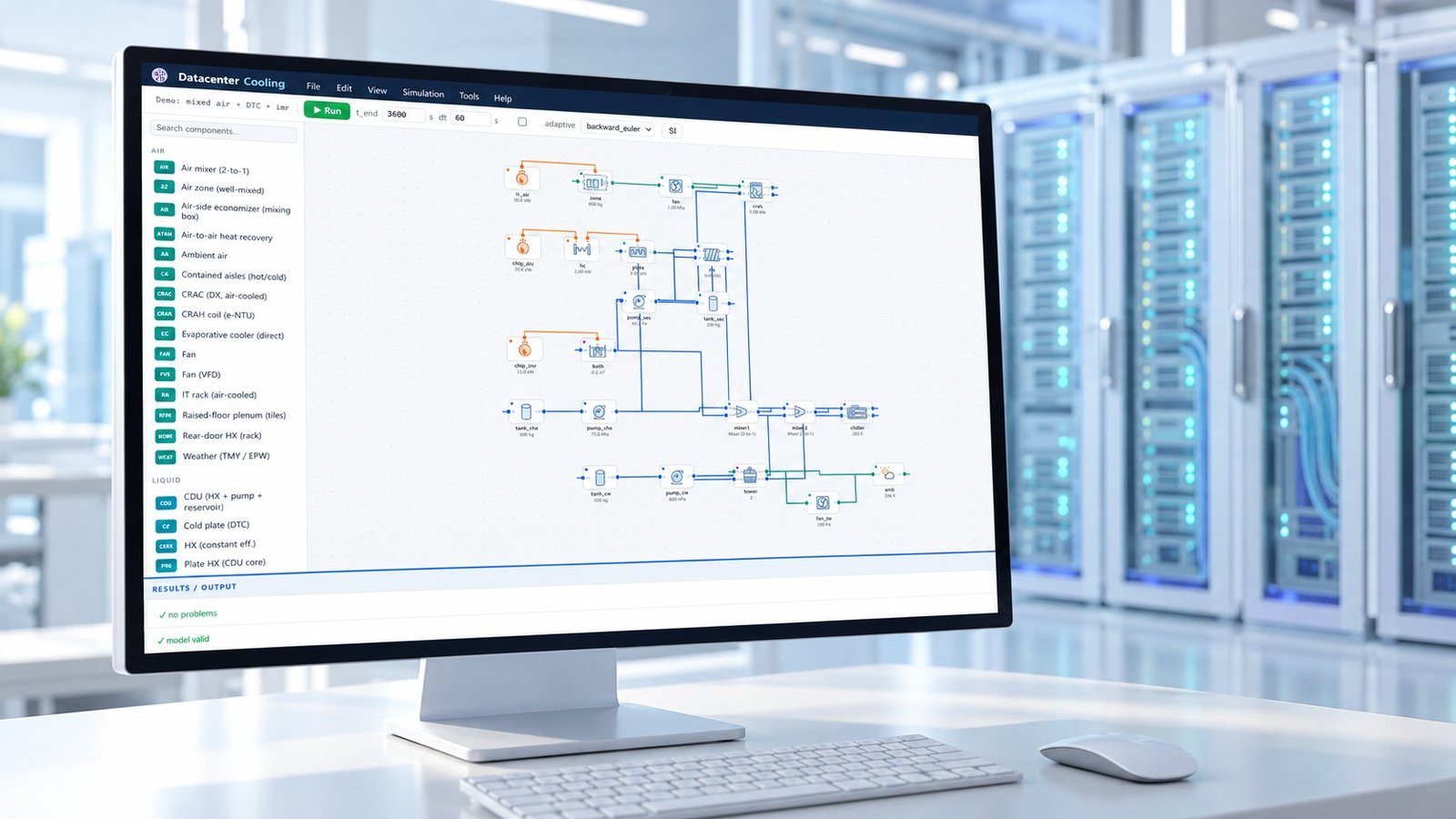
Compare data center cooling system companies by scoring thermal boundary, named equipment, rated capacity, facility heat rejection, service ownership, and deployment evidence. Then test 100 kW, 200 kW, and 400 kW rack loads so capacity margin and failure triggers are visible before procurement.
Recent consolidation makes that test more important. Ecolab’s July 2 announcement says it closed the approximately $4.75 billion CoolIT acquisition, while CoolIT sales had grown more than 100% year to date. nVent’s July 31 release announces a new 160,000-square-foot Minnesota facility, more than 400,000 square feet of liquid-cooling expansion overall, and more than 2 GW deployed. Neither announcement proves technical superiority.
Why are data center cooling system companies changing now?
The market is consolidating while manufacturing capacity expands. Buyers should therefore score ownership, scale evidence, and execution risk instead of trusting a supplier list. The Construction Placements list is useful for discovery. DataCenterChill’s supplier database is useful for filtering architectures and evidence states.
DataCenterChill reports 36 matching records, with 34 marked company reported and 2 marked source checked. The ranking pages list suppliers and use cases, but they do not show how to score ownership, scale evidence, or execution risk after consolidation. That is the gap this matrix fills.
What should your shortlist matrix score?
Your shortlist should make the cooling boundary auditable. A capacity number is incomplete unless you also know who owns the heat exchanger, chiller, dry cooler, tower, controls, commissioning, and service response.
| Thermal architecture boundary | Named product or model | Rated capacity | Facility-side heat-rejection responsibility | Commissioning/service owner | Manufacturing or deployment evidence | Use when |
|---|---|---|---|---|---|---|
| Direct-to-chip rack loop and CDU interface | CoolIT CHx2000 | 2 MW | Write whether the plant includes a chiller, dry cooler, tower, heat exchanger, and water treatment. | Assign rack-loop commissioning and facility-plant commissioning separately. | Ecolab reported closing the approximately $4.75 billion CoolIT acquisition on July 2; CoolIT sales were reported up more than 100% year to date. | Use when you need rack-level liquid distribution with a clear plant boundary. |
| Modular CDU combinations for liquid cooling | LiquidStack GigaModular CDU | Up to 14 MW | The RFP must name the owner of heat rejection, controls, water quality, and heat-reuse equipment. | Require one accountable party for integrated testing across CDU and facility loops. | Use the public product capacity as a comparison point, then request project-specific deployment evidence. | Use when modular scale and phased capacity matter. |
| Liquid-cooling portfolio and manufacturing expansion | nVent liquid-cooling portfolio; model not stated in the cited release | More than 2 GW deployed as portfolio evidence, not a unit rating | Confirm which plant equipment and service scope sit inside the nVent contract. | Require the commissioning plan, spares list, and local service owner. | nVent reported a new 160,000-square-foot Minnesota facility, more than 400,000 square feet of expansion overall, and more than 2 GW deployed. | Use when supply capacity and delivery execution are procurement gates. |
- Boundary: identify the rack loop, CDU, secondary loop, heat exchanger, and heat-rejection plant.
- Evidence: separate company-reported claims from independently checked deployments.
- Ownership: name the commissioning and service owner for every loop.
- Failure test: define what happens after one redundant pump is unavailable.
How do you compare three cooling architectures at 100, 200, and 400 kW?
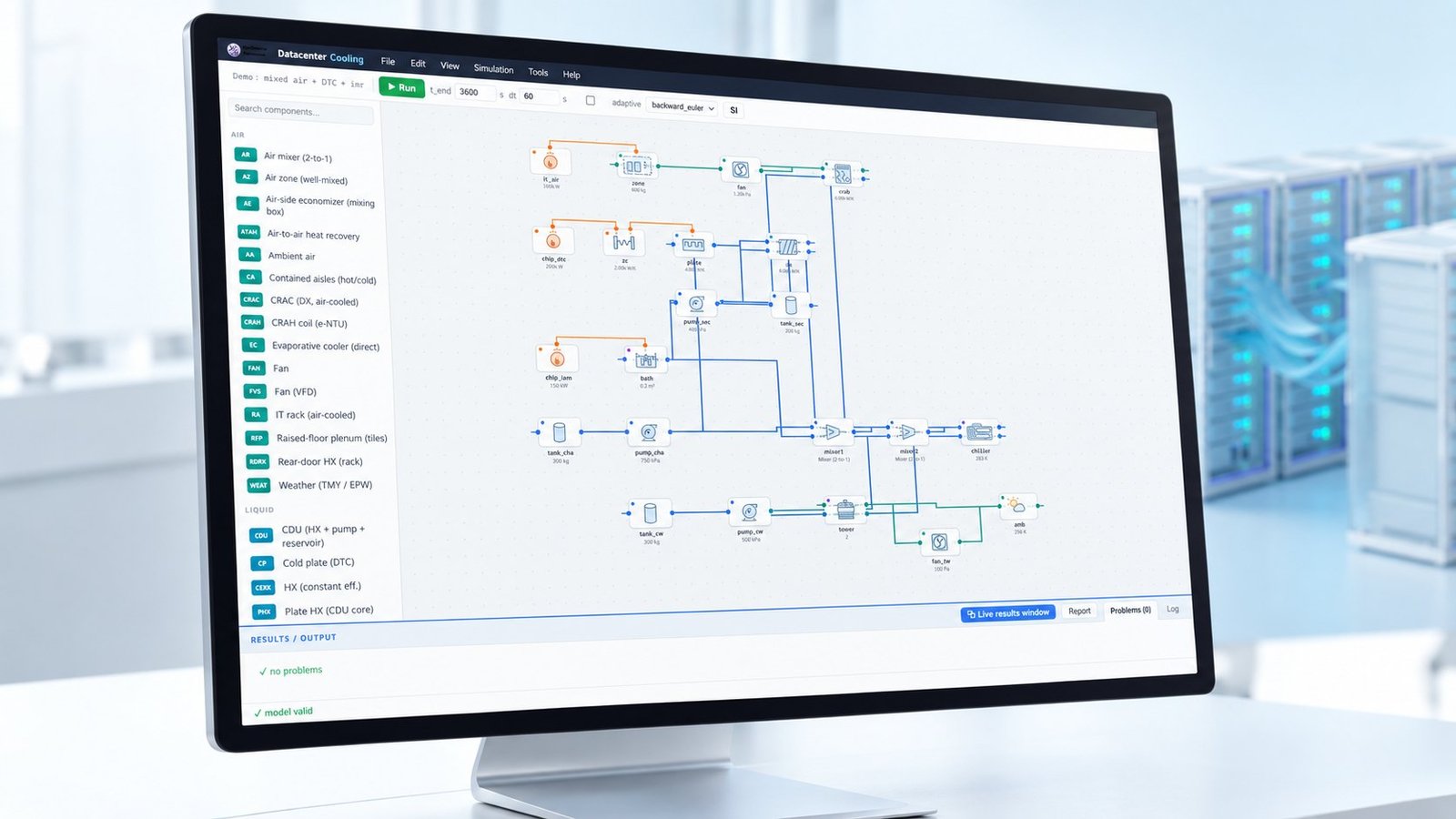
Multi Optimization’s anonymized parallel comparison uses three architecture families and five objectives: capacity margin, pump power, footprint, water demand, and redundancy. The screening case uses NSGA-II with 64 candidates over 40 generations, a 3,600-second transient, 60-second time steps, backward Euler integration, and SI units.
The values below are anonymized model outputs, not vendor datasheet claims. Capacity margin is available heat-removal capacity divided by modeled load. Water demand is facility makeup demand from the selected heat-rejection path.
| Architecture | Rack load | Capacity margin | Pump power | Footprint | Water demand | Redundancy or failure trigger | Pareto result |
|---|---|---|---|---|---|---|---|
| A — direct-to-chip CDU with redundant pumps | 100 kW | 1.35x | 2.6 kW | 4.8 m² | 0.00 m³/h makeup | Passes one-pump loss test | Pareto front |
| A — direct-to-chip CDU with redundant pumps | 200 kW | 1.22x | 5.1 kW | 6.1 m² | 0.00 m³/h makeup | Passes with reduced margin | Pareto front |
| A — direct-to-chip CDU with redundant pumps | 400 kW | 1.08x | 10.2 kW | 10.9 m² | 0.00 m³/h makeup | Fails if remaining flow falls below 80% of design after one pump loss | Near front |
| B — rear-door heat exchangers with chilled-water plant | 100 kW | 1.18x | 4.8 kW | 7.4 m² | 0.12 m³/h | Passes N+1 plant test | Pareto front |
| B — rear-door heat exchangers with chilled-water plant | 200 kW | 1.10x | 9.4 kW | 8.8 m² | 0.24 m³/h | Passes with plant-side reserve | Pareto front |
| B — rear-door heat exchangers with chilled-water plant | 400 kW | 0.96x | 18.6 kW | 14.7 m² | 0.48 m³/h | Fails when the plant-side heat-rejection path is excluded | Dominated at 400 kW |
| C — single-phase immersion with CDU | 100 kW | 1.42x | 1.9 kW | 6.6 m² | 0.03 m³/h | Passes one-pump loss with tank isolation | Pareto front |
| C — single-phase immersion with CDU | 200 kW | 1.30x | 3.7 kW | 8.0 m² | 0.06 m³/h | Passes one-pump loss with tank isolation | Pareto front |
| C — single-phase immersion with CDU | 400 kW | 1.16x | 7.2 kW | 12.8 m² | 0.12 m³/h | Passes if tank isolation and service bypass are available | Pareto front |
The Pareto front contains solutions that are not worse across all five objectives. At 400 kW, architecture B drops out because facility-side heat rejection and redundancy become binding constraints. The primary failure trigger is loss of flow after a redundant pump is unavailable. The second is a vendor scope that excludes the heat-rejection path.
If PUE is your next decision gate, use How to Reduce Data Center PUE: Simulation-Driven Cooling Design to connect plant energy with rack-level thermal behavior.

How should a data center cooling RFP test AI cooling suppliers?
A data center cooling RFP should test AI cooling suppliers against the same boundary, transient, redundancy, and service conditions. Make the vendor prove the complete thermal path before comparing price or footprint.
- Define the boundary. List the rack, CDU, secondary loop, heat exchanger, chiller or dry cooler, tower, controls, water treatment, and heat reuse path. Failure mode: the vendor excludes the heat-rejection equipment needed to meet the rated load.
- Run the load sweep. Test 100 kW, 200 kW, and 400 kW rack cases with a 3,600-second transient and 60-second steps. Failure mode: capacity margin collapses at the design point or the model hides a short flow interruption.
- Remove one redundant pump. Recalculate flow, supply temperature, return temperature, and rack heat rejection. Failure mode: remaining flow falls below 80% of design or the controls do not generate a service alarm.
- Assign commissioning ownership. Name the party responsible for factory acceptance, site acceptance, integrated controls, spare pumps, leak response, and service escalation. Check the heat-exchanger treatment against ANSI/ASHRAE Standard 90.4-2022, Section 6.4.1. Failure mode: no single party owns the integrated plant.
- Audit the evidence. Require a named product or model, rated capacity, deployment record, manufacturing location, and evidence status. Failure mode: company-reported capacity is treated as an independently checked deployment.
For retrofit constraints, continue with Data Center Cooling Software for AI Rack Retrofits. For compliance questions, compare cooling systems for ai data centers. If you need reduced-order exploration before full CFD, review the site’s cfd software guidance.
Frequently asked questions
Does a 2 MW CDU cool a 2 MW data hall?
No. A 2 MW CDU rating describes a cooling boundary. Your model must still assign the heat exchanger, chiller, dry cooler, tower, controls, and water treatment needed to reject that heat.
What counts as deployment evidence?
Use a named product, a stated capacity, a project or manufacturing reference, and a clear evidence status. Separate company-reported claims from source-checked records.
What failure should you simulate first?
Remove one redundant pump and test whether the remaining loop maintains required flow and temperature. Also fail the facility heat-rejection path if the vendor scope does not include it.
What should you do next?
Select data center cooling system companies with a scored boundary, verified scale evidence, assigned service ownership, and a surviving Pareto solution. Multi Optimization Admin uses parallel multi-objective optimization across TRNSYS, EES, COMSOL, and AI surrogate workflows. Run your shortlist through our data center cooling systems simulation workflow before issuing the final purchase specification.