
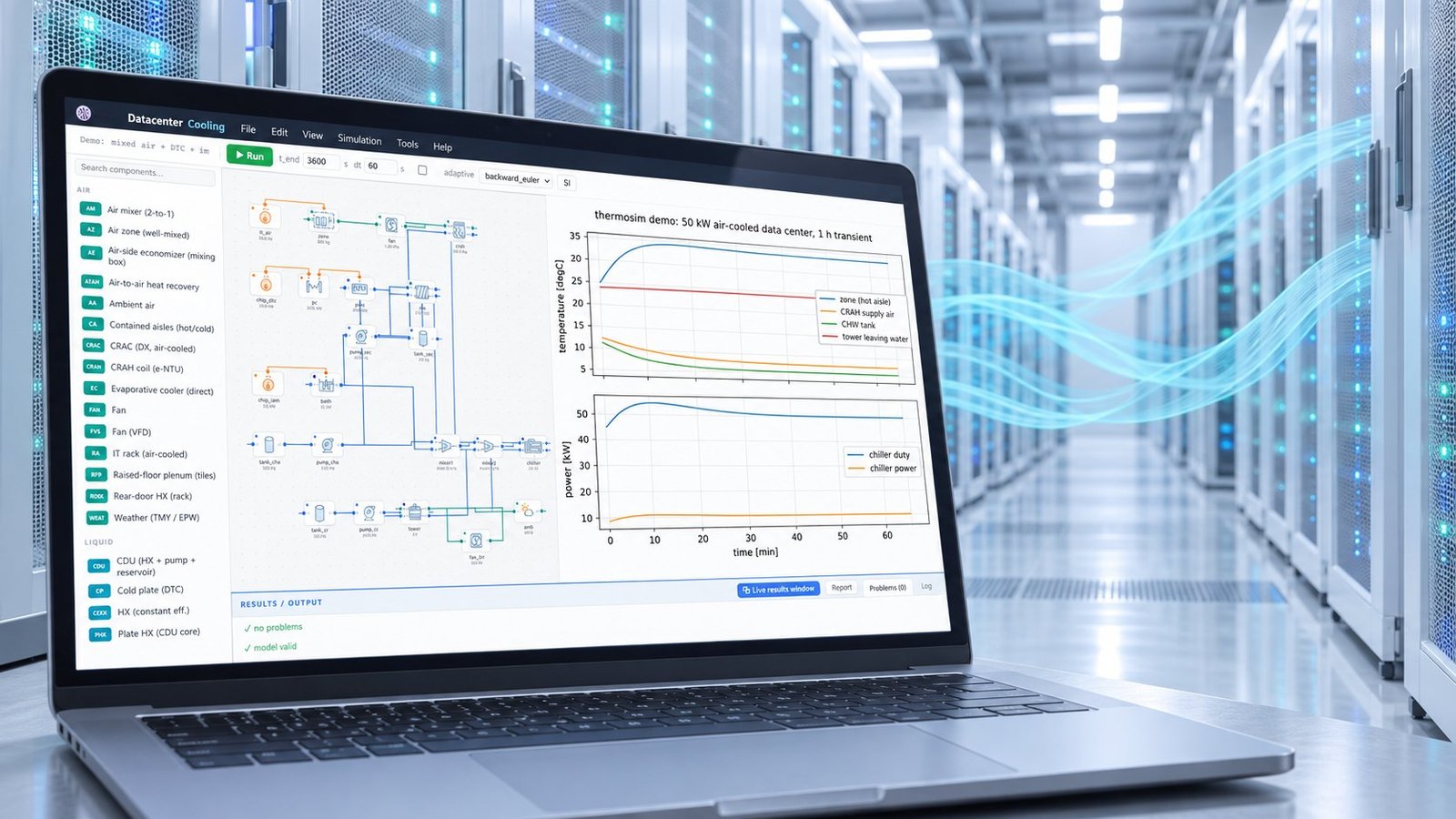
NVIDIA DSX Ready CDU qualification is a product-level signal, not a site acceptance certificate. Use it to shortlist a specific CDU, then prove your installed configuration against rack heat load, loop temperature, flow, pressure, failover, and leak isolation. Your acceptance record should name the qualified model, site configuration, numerical triggers, and recovery results.
The September 2026 launch makes AI factory CDU qualification a live procurement issue. The missing step is site evidence. Multi Optimization Admin uses transient simulation to turn qualification documents into testable limits for your racks, branches, pumps, and controls.
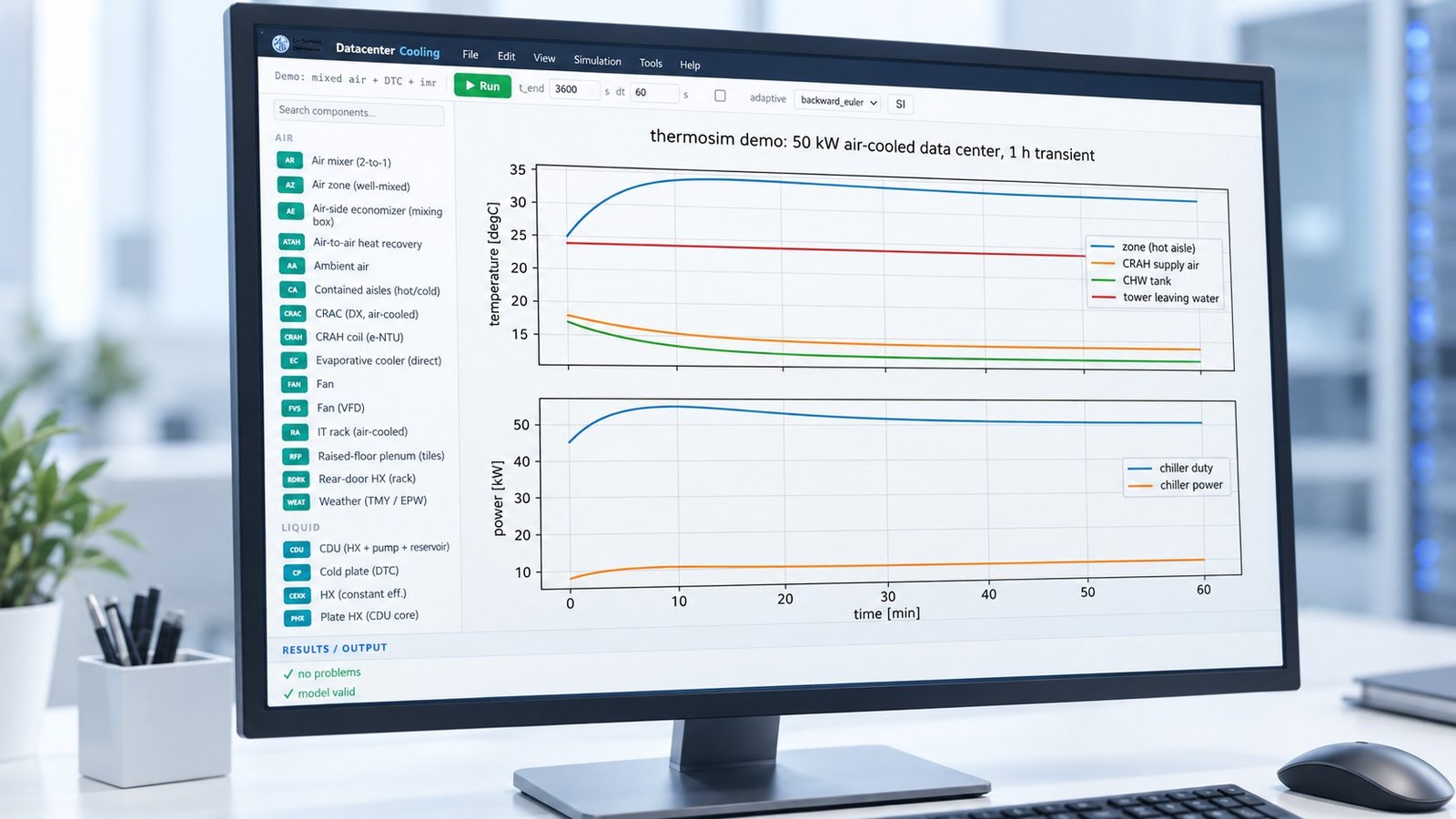
What does NVIDIA DSX Ready CDU qualification prove?
NVIDIA’s DSX Ready page states that qualification applies to a specific product or solution that completes the applicable category requirements. It does not qualify the supplier’s entire portfolio. The technical requirements also vary by solution area, so a DSX Ready CDU is evidence for that submitted CDU offering, not for every piping layout or operating condition.
What the designation does not prove
The designation does not prove performance in every climate, elevation, water chemistry, branch arrangement, or control sequence. You still need engineering for the facility configuration. Record the exact product designation, revision, control firmware, pump arrangement, heat exchanger boundary, and connected rack population.
- Verify that the procurement line item matches the qualified product or solution.
- Request the applicable DSX CDU requirements and qualification scope from the supplier.
- Map the qualified boundaries to your primary loop, secondary loop, rack manifolds, and controls.
- Define site acceptance limits before equipment delivery.
- Retest after filter changes, pump changes, branch additions, or control-sequence changes.
Which DSX Ready CDU evidence should you compare?
Compare qualification scope, capacity, loop architecture, and site fit together. Vertiv’s September 21, 2026 release identifies its 2.3 MW CoolChip liquid-to-liquid CDU as qualified specifically as a NVIDIA DSX Ready CDU. LG Electronics’ July 27, 2026 release describes a 600 kW CDU evaluated against more than 100 technical criteria and reports stated temperature-control precision of ±0.25°C.
Vertiv says the 2.3 MW model supports direct-to-chip and rear-door heat exchanger applications, with installation at a row end or room perimeter. LG’s validation evidence is useful for comparison, but you should not treat every validation statement as the same qualification scope. Confirm the exact product and category before making a liquid-to-liquid CDU selection.
| Evidence | What it tells you | Use when |
|---|---|---|
| NVIDIA DSX Ready designation | A specific product or solution completed the applicable NVIDIA qualification path. | Shortlisting qualified building blocks. |
| Vertiv CoolChip 2.3 MW CDU | Vertiv identifies this liquid-to-liquid model as the first CDU specifically qualified as NVIDIA DSX Ready. | Evaluating high-capacity direct-to-chip or rear-door heat exchanger deployments. |
| LG 600 kW CDU | LG reports more than 100 technical evaluation criteria and ±0.25°C temperature-control precision. | Checking a lower-capacity reference point and precision requirement. |
| Site simulation and commissioning record | Your installed configuration meets defined thermal, hydraulic, alarm, and recovery limits. | Making the final purchase, handover, and operating decision. |
For the air-side consequences of CDU changes, connect the hydraulic model to How to Reduce Data Center PUE: Simulation-Driven Cooling Design. For geometry-heavy studies, use the site’s cfd software workflow to check whether your training data covers the required operating envelope.
How do you convert DSX evidence into a site acceptance matrix?
Start with a named transient model and six measurable boundaries: rack heat load, secondary-loop supply temperature, flow rate, pressure, residual air load, and recovery behavior. We use configuration IDs so procurement, simulation, commissioning, and operations refer to the same test case.
Recommended model and test setup
Our screening model is MO-CDU-ACC-01, a 3,600-second backward-Euler transient with a 60-second step. We run a separate 1-second event model for pump trips and branch restrictions. The site energy review should also record the applicable mechanical-system boundary under ASHRAE Standard 90.4-2022, Section 6.4. That energy review does not replace thermal acceptance.
| Test ID | Configuration ID | Site criterion | Example result | Pass/fail rule |
|---|---|---|---|---|
| TH-01 | MO-DSX-2300-L2L-A | 1.80 MW rack heat; 30.00 ±0.25°C supply; flow ≥86.0 L/s; farthest branch ≥2.0 bar(g) | 30.18°C; 87.1 L/s; 2.08 bar(g) | Pass if all values remain inside limits for 900 s. |
| TH-02 | MO-DSX-600-L2L-B | 0.48 MW rack heat; 30.00 ±0.25°C supply; flow ≥23.0 L/s; farthest branch ≥1.8 bar(g) | 30.11°C; 23.4 L/s; 1.86 bar(g) | Pass if supply temperature stays within tolerance and branch pressure remains stable. |
| HY-01 | MO-DSX-2300-L2L-A | Residual air load ≤50 kW after liquid-loop operation stabilizes. | 42 kW residual air load | Pass if air-side cooling remains below the site limit for 600 s. |
| RF-01 | MO-DSX-2300-L2L-A | Standby-pump recovery ≤15 s; leak-isolation response ≤5 s. | 12 s pump recovery; 4 s isolation | Pass if no rack inlet exceeds 30.25°C during recovery. |
- Load the rack schedule and set the maximum heat step. Failure mode: an undersized CDU passes at steady state but fails during the ramp.
- Set secondary supply temperature, commanded flow, and minimum far-branch pressure. Failure mode: a control valve masks low flow at the CDU while a remote branch starves.
- Inject the residual air load and verify the air-side limit. Failure mode: liquid cooling appears adequate while room-level heat remains above the design allowance.
- Trip the duty pump and isolate a branch after filter service. Failure mode: the system recovers hydraulically but exceeds rack inlet temperature.
- Save alarms, timestamps, peak temperature, minimum flow, minimum pressure, and recovery time. Failure mode: a pass cannot be reproduced during commissioning.
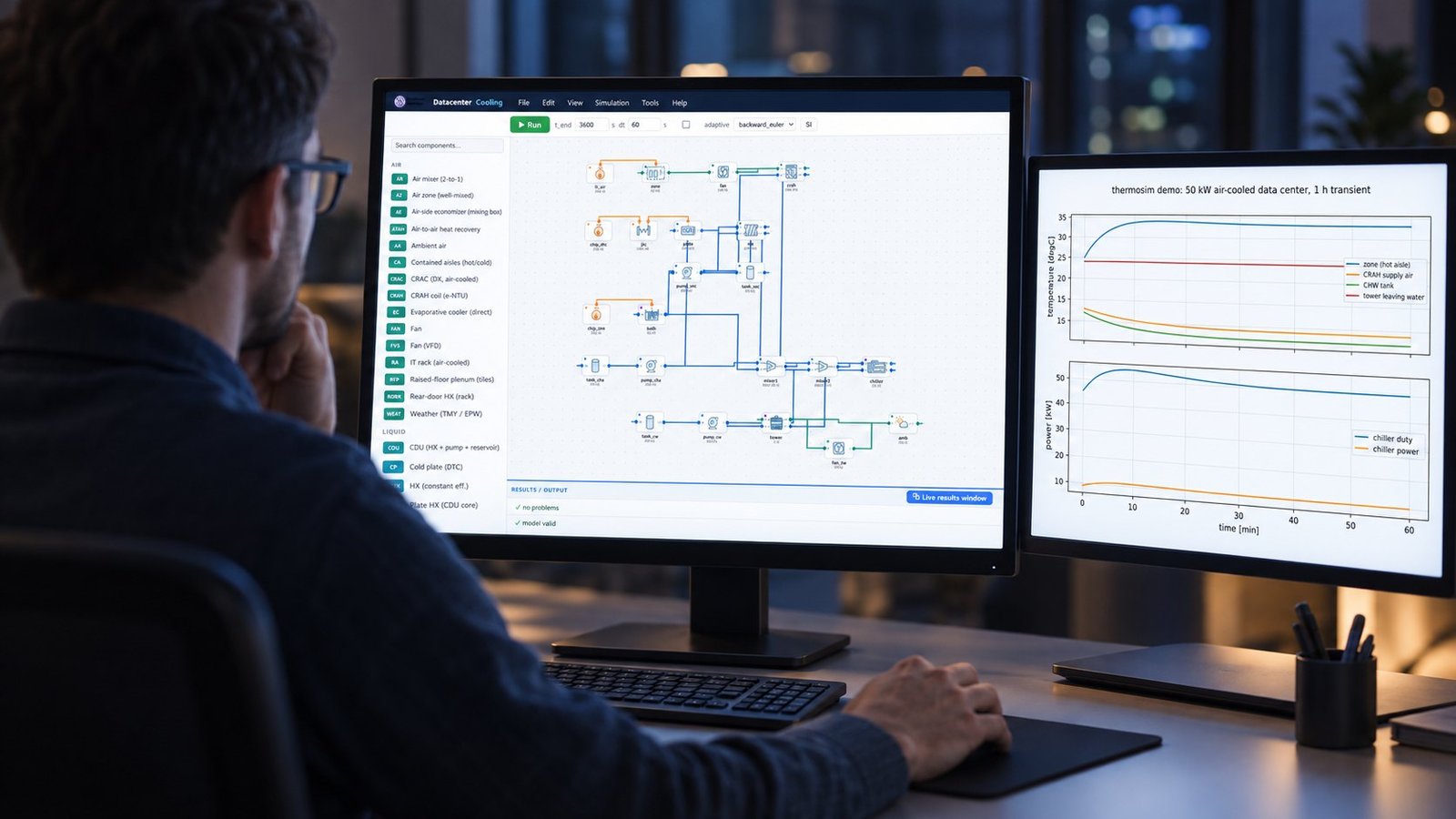
What happens when a pump trips or filter service cuts branch flow?
A useful acceptance run includes a controlled failure, not only a stable-load snapshot. In our worked example, the pump trip and post-service filter restriction use explicit numerical triggers, alarm thresholds, and recovery results. The values below are simulation acceptance targets and example results, not vendor claims.
Worked scenario: MO-DSX-2300-L2L-A
- At t=600 s, trip duty pump P-01 while the rack load is 1.80 MW. The low-flow alarm triggers when total flow falls below 77.4 L/s, equal to 90% of the 86.0 L/s command, for 3 s.
- Start standby pump P-02 automatically. The example model restores 83.2 L/s at t=612 s and reaches 87.0 L/s at t=615 s. Peak secondary supply temperature is 30.22°C, below the 30.25°C alarm limit. Result: pass.
- At t=900 s, reduce branch B-07 flow from 4.80 L/s to 4.10 L/s after filter service. The branch alarm triggers below 4.32 L/s, equal to 90% of command, for 10 s.
- Replace the filter and restore the branch valve. The example model reaches 4.76 L/s at t=945 s, with rack inlet temperature returning to 30.14°C. Result: pass.
- Inject a simulated leak signal on B-07. Close the isolation valve within 5 s and confirm that neighboring branches remain above 95% of commanded flow. Result: pass if the isolated branch reaches zero flow without a neighboring rack temperature excursion.
Use the same event logic for retrofit studies. The Data Center Cooling Software for AI Rack Retrofits workflow helps you test branch additions before they become commissioning failures. For larger design spaces, the CFD PINN Data Center Design for Cooling Optimization workflow can reduce the number of full CFD evaluations while preserving the failure cases you need to inspect.
NVIDIA DSX Ready CDU acceptance FAQ
Does DSX Ready qualify an entire supplier portfolio?
No. NVIDIA states that DSX Ready applies to a specific qualified product or solution. Other products require separate qualification or separate engineering evidence.
Does qualification replace site engineering?
No. Vertiv’s September 21, 2026 release explicitly says qualification does not replace engineering for the particular facility design, system configuration, or operating requirements.
What should your commissioning record contain?
Record the qualified product, configuration ID, load profile, supply temperature, flow, pressure, residual air load, alarm thresholds, failover time, isolation response, and measured recovery result. Include the model timestep and control sequence.
How should you use DSX Ready evidence?
Use NVIDIA DSX Ready as a disciplined procurement filter, then use simulation and commissioning to prove your own site configuration. A qualified CDU can reduce uncertainty at the product boundary. It cannot guarantee performance across every climate, piping layout, branch balance, or failure sequence. For the next design step, see our thermal cooling systems for AI simulation workflow.